SGM Herbert A. Friedman (Ret.)
PSYOP Intelligence Notes
During the height of the Vietnam War the United States dropped millions of propaganda leaflets over the North Vietnamese and Viet Cong enemy. This was a “white” operation and above board. At the same time, a “black” operation was quietly taking place. Some of the aircraft taking off from the air bases in Okinawa headed straight for Vietnam; others secretly veered off and dropped their leaflets on North Korea. The reader can find a complete discussion of this operation in my JILLI article . This short article will only be about the reactions of the enemy and statements of the North Korean defectors who saw the leaflets in their homeland and the interrogation statements of the spies from the north that were caught in the south.
The Target Analysis Section of the 7th PSYOP Group published a newsletter called PSYOP Intelligence Notes. It was full of all kinds of information. It explained North Korean holidays, speech, the way they address each other, their use of mysticism using special days from calendars, and even such menial things as chewing gum and playing cards. In this article I will show a number of leaflets and the intelligence report of what North Korean defectors and captives thought of those leaflets, and intersperse interesting comments from the non-leaflet comments.
I should point out that in the early years of the Jilli (later Focus Truth) operations, people were very skeptical about the credibility of the leaflets. However, as South Korean leaflets were more frequently dropped and in greater quantities, and as they saw more and more types of leaflets, people, with the exception of some devoted party members, gradually began to act more positively to the leaflets in spite of the fact that Communist leaders claimed that all photographs on the leaflets had been taken in Japan or other Asian countries for the sake of propaganda.
Lieutenant Colonel David Underhill
Perhaps we should start by talking about how and why leaflets are produced and disseminated. The next few paragraphs were written by Lieutenant Colonel David Underhill, a good friend of mine who oversaw this operation.
THE STRATEGIC LEAFLET
To understand the use of the leaflet in psychological operations, the goals of the leaflet should first be discussed.
In tactical psychological operations, it is desired that the leaflet produces an immediate reaction on the part of the enemy. The tactical leaflet is designed to cause the enemy to surrender, rally to the friendly side, or perhaps cause civilians to leave an area where operations are pending. The tactical leaflet may have a direct bearing on the physical condition of the target member by alluding to the fact that he is surrounded, faced with overwhelming odds, or subjected to superior firepower. In these instances, the threat of death is implied. As a safe conduct pass, the tactical leaflet offers an avenue of escape from a depressing situation and hope to the despairing who have come to believe their situation hopeless. The tactical leaflet is usually tied to a particular event or situation which makes the timing of its dissemination critical
The strategic leaflet differs from the tactical leaflet in both its message and application. It does not carry a theme that would necessarily produce immediate defection or bring about sudden dramatic change in each situation. A strategic leaflet strives for the long-range effect. Its objective goes far beyond that of the tactical leaflet in that it aims at the gradual change of attitudes and beliefs over a relatively long period of time. In some instances, the objective of a strategic leaflet can be the same as that of a tactical leaflet. For example, a defection appeal could be used in a strategic leaflet program as well as in a tactical program. However, the objectives of the strategic program, while essentially the same as those of the tactical program, would be realized over a much longer period and by far more subtle means. By using a low-key approach and telling the truth about a friendly country, it is possible to create doubt in the minds of the target audience. This initial doubt, if continuously reinforced by credible strategic propaganda, can lead to further doubt, questioning of enemy domestic propaganda, and finally the conviction that the friendly country has told the truth. The goal of a well-conducted strategic program is to have the target member convince himself over time of the truth of the friendly message. Defection is by no means the only objective in strategic psychological operations. Creating dissatisfaction with a particular form of government or way of life can also be a primary goal and one that readily lends itself to the gradual processes of strategic psychological operations. It must be remembered that in many cases, the strategic leaflet is the only method of reaching vast numbers of people whose only other source of information is enemy-controlled propaganda.
Photographs, since they represent reality, are one of the best tools for creating the credibility desired in strategic psychological operations. Consequently, the leaflet provides the best method of assuring that these photographs with accompanying messages are disseminated over the largest areas to the largest possible audience. Leaflets with bright, colorful photographs attract attention and are likely to be picked up and possibly discussed openly, especially by children who are at an impressionable age and will probably collect them and bring them home. In cases where the population is told not to pick up or read the leaflets, the question begins to arise in the minds of the would-be readers as to exactly why the leaflets must not be read. The psychological process has already begun.
One of the prime objectives in strategic psychological operations is to stimulate the target audience to inquisitive thought and, in doing so, to discredit some aspects of Communist propaganda. If the target member can be persuaded to reject some small aspect of Communist propaganda as untrue, the way is open to cause him to reject the belief that all Communist propaganda is true. The corollary then, that the Communist form of government is necessarily the best form of government and that the non-Communist world is tottering on the brink of social and economic collapse also becomes subject to rejection.
Leaflets with texts telling of economic expansion and progress, accompanied by supporting photographs, can play a significant role in discrediting the Communist propaganda line that the non-Communist world is in economic decay. To the reader who has been told that the industrialization and economic conditions of the friendly country are in bad shape, evidence to the contrary will come as a surprise. This will raise doubts in his mind concerning other propaganda about the friendly country or the non-Communist way of life. For example, if claims made in a leaflet about economic advancement or industrial expansion are true, the reader then has grounds for making the deduction that a firm foundation other than Communist must exist on which to base this economic advancement or industrial expansion Again, leaflets telling of the living conditions and standards of the average citizen of the friendly country tend to cause the reader to make an automatic comparison between his own living conditions and those reported on the leaflet. From the question as to whether such information might be true comes the reader's suspicion that information given by his own government or political officers is not true. This suspicion, carefully nurtured, can lead to doubt in the ability of the Communist form of government to provide the best possible life for the people. Again, it must be emphasized that long periods of time are required for these mental processes to take place.
Many themes may be read on many leaflets before a target member finds a theme or photograph with which he can identify. However, once this identification occurs, all the previously disregarded and discounted leaflet themes come into question. If the reader can recognize one theme as being true, perhaps he will be led to believe that all the leaflets are true.
A long period of time is required before the target audience can get together in any organized manner. This is the long period of time inherent in any strategic psychological operation where the goal is the changing of an unfriendly nation's form of government, economic conditions, or attitudes toward a friendly country.
Leaflet 42-65
The issue of 7 June 1968 mentioned a 35 year-old male agent who infiltrated south in 1967. It said that while patrolling with his team he had run across leaflet 42-65. The leaflet depicted differences between North and South Korea. His Battalion commander appeared and confiscated the leaflet and warned him against reading such enemy propaganda. In this case the agent was not impressed with the leaflet and believed it was just printed to criticize the social system of North Korea. Although it showed the austerity of the north, the agent did not find that wrong or insulting. That was just the way it was. The text mentions a modern cement factory in the South. One building in the picture has sign reading Ssangyong Cement:
The output of cement for economic growth increases.
The number of factories producing cement grows as well every year.
In the South, as evidenced by the photo, the modern skyscrapers of concrete are crowding the skyline. The cement used for the construction of these buildings is produced domestically in the South.
Topical Reports
Besides PSYOP Intelligence Notes, the 7th PSYOP Group also published Topical Reports. Many of the small comments I add in this article between the leaflets is from this second publication.
Communist Education
The North Korean Communist Party makes it the prime object of education to foster “personalities who will think, talk, and act exactly as the Party wants.” North Korean youths were forced unconditionally to accept Communist ideas selected by the Party, and their ways of thinking and acting must be based on such ideas. Those that understand and obey the concept should be willing to lay down their personality, their consciousness, and even their life for the Party under the slogan “One for the whole.”
Author's note: As I read this I thought of the death of Spock in Star Trek when he told Captain Kirk, “The needs of the many outweigh the needs of the few, or the one.”
Leaflet 123
This leaflet is designed to show the ability to produce electricity of South Korea. It features four photographs of a dam and various power plants on the front and back. The North Korean military defector, formerly a Senior Private who defected in 1967 was apparently fully brainwashed by the North. He said:
My fellow soldiers and I were not impressed with this leaflet because we knew that the output of the South Korean electrical power plants was far less than that of the plants in North Korea.
The leaflet text is:
ELECTRICITY OF SOUTH KOREA
Rapid Growth
The electricity generation facility is expanding all the time and the supply of electricity is limitless without any rationing.
The Korean Electricity Company is located in Seoul and it contributes toward the people's daily lives and the development of industries.
Choonchun hydroelectric power generation station which was constructed in 1964 has the hydro-power generation capacity of 57,600 kilowatts
Leaflet 132
The issue of 7 June 1968 mentioned a 23 year-old spy who came south in March 1967. While walking around the safe-house where he was being trained he found leaflet 132 on the ground. He said that he believed the North Korean propaganda at the time and thus could not believe the message on the leaflets. He believed that the buildings and multiple cars were pictures of Japan.
Hooliganism by North Korean Youth
Some North Korean school graduates who became dissatisfied with the menial jobs they were assigned, deserted them and their rural homes and moved to Pyongyang where they became wanderers in the streets. Because they left their jobs they lost their food allotment and were forced to turn to theft and pick-pocketing.
North Korea’s own propaganda sometimes becomes a problem for them. The farmers were told regularly about the wonderful fertilizer plants built by Kim Il-sung. As a result, they stopped collecting manure and materials to compost. Suddenly the crops were suffering. Kim had to give a direct order to return to collecting manure. The same thing happened with scrap. The people were told that raw material was abundant, and they stopped collecting scrap. Kim had to order the people to go back to collecting scrap because it was needed for their economy.
Defections of Military Personnel
The number of people induced to defect through psychological operations is a poor measure of PSYOP effectiveness. In the case of attempted defection from North Korea by land route, to be successful a defector must cross two- and one-half miles of DMZ. He stands a very good chance of being apprehended by his own security forces, killed in the process by stepping on land mines, or killed by South Korean forces before he can make his intentions known. In a peace time situation, defection inducement may not even be a valid strategic PSYOP objective. To induce all dissatisfied elements within a society to seek a new way of life elsewhere relieves considerable pressure from the governing element for change within that society. The massive airlift of Cubans out of Cuba drew some criticism because of the actual "service" rendered to the Cuban Government by the removal of the group who did not desire to remain under the new Government. The above notwithstanding, defection is one measure of effectiveness and the following comments made by defectors indicate leaflets played some part in their final decision to defect to South Korea.
Leaflet 134
Leaflet 134 disseminated in pictures Lieutenant YI P’il-eun, a North Korean naval defector. He was a chemical engineer at the 163rd Unit of the 7th Naval Base Command (Haeju) in North Korea, is speaking about the dire situation in North Korea and the remarkable development of South Korea in a press conference with South Korean reporters after he defected to South Korea. The North Korean government regularly told the people that defectors to the South were immediately shot. This leaflet showed Lt. YI at a press conference as proof that he was well treated. North Korean defectors who evaluated the leaflet said that they felt assured that they would be safe should they go over to the Republic of Korea.
The Topical Reports issue of 7 June 1968 mentioned a 36-year-old male crewman on a spy boat that was captured in April 1967. He knew about the leaflet that featured Navy Lieutenant Yi and was dropped over North Korea in December 1965. Because of the leaflet drop, Lieutenant Yi’s defection to the south was common knowledge all over the North. The captive spy was a true believer in Communism and was not impressed by this leaflet. He believed that Lieutenant Yi was a traitor who betrayed his nation. The defectors who went south to be free felt quite different.
Defector 1 – “After seeing this leaflet, I came to realize that if I defected to South Korea, I would receive a warm welcome.”
Defector 2 – "Through these leaflets that I learned that Lieutenant Yi had defected and not been kidnapped by the Americans at Panmunjom as he had been told. The North Koreans had his children broadcast an appeal to the people with tears in their eyes to avenge their father’s kidnapping."
Defector 3 – "I became determined to defect after reading a leaflet describing the warm reception of a North Korean Navy defector. After studying the leaflet, I and a friend resolved to escape to the south because we were tired of the hard labor, the constant surveil-lance, the ever-short rations, and the unhappy life in North Korea. My friend drowned in the attempt to swim the Han River to safety."
Defector 4 – "My father was executed in February 1951, for collaborating with the United Nations Forces, and because of this the family was branded as reactionary. My mother and I were sent to a Cooperative Farm where we and other "reactionary" members were forced to work in the fields from 0400 to 2000 hours every day, including Sundays, under surveillance of the "Core Group," the trusted workers. In April I picked up a leaflet which referred to the defection of a North Korean Navy Lieutenant and contained a statement made by him at a press interview. I and another "reactionary" member resolved to defect to South Korea because we were tired of the excessively hard labor, the surveillance, the short rations, and the generally unhappy life in North Korea."
Defector 5 – "I observed many leaflets on many occasions between the time I first saw leaflets and the time I defected to South Korea (a period of 27 months). During the summer of the second year, I observed leaflets almost every day. The leaflets I observed were generally impressive and very informative and educational. I was particularly impressed with the leaflets showing a former North Korean Navy Lieutenant who defected to South Korea and another showing a former North Korean Army defector to South Korea. These two leaflets led me to believe that North Korean defectors to South Korea were warmly welcomed by the Government. My decision to defect was influenced by these two leaflets."
JILLI Leaflet Mix 18 Showing the Lieutenant Yi Leaflet
These leaflets would be mixed and dropped TogetherNorth Korean Military Grievances
Leaflet 62
A leaflet that showed the good life of those in the South Korean military. The images are mostly of the young soldier going about town with his girlfriend. He has complete freedom to go where he likes without being watched or harassed. He makes military life look very inviting. The text on the front and back is:
The Republic of Korea Army enjoys 25 days of vacation time each year.
Your family will be waiting for you, too.Enjoy your vacation time!
Happy people enjoying liberty & peace.
"Will he have arrived back at base by now?"The period of military service is indefinite and there is no leave. You cannot select an occupation after discharge; you will be ordered to a job selected by the government. You cannot marry while in the military. You cannot get promoted unless the political Officer recommends you.
Note: South Korean propaganda often points out that the North Korean soldier rarely gets leave. This simple scene of a South Korean soldier enjoying time off with his girlfriend was probably very difficult for the Northern soldier to see.
A defector said about this leaflet:
"The leaflet on the South Korean Army leave system was dropped into the area of my unit in large quantities from September (of the second year) until the early part (of the third year). During this period rumors had been circulating that the term of North Korean military service would be extended and that the leave system would be discontinued. For this reason, discontent began to develop among North Korean troops. Since the leaflet was dropped at this very time the leaflet was very effective. I accepted the message of the leaflet that the ROK soldiers are allowed to go on leave because I learned about it also from South Korean loudspeaker broadcasts along the DMZ."
(NOTE: The inexperienced psychological operator tends to "jump" on an enemy vulnerability by a direct attack attempting to tell the enemy all about his experience has shown this to be a poor technique. This leaflet program has been most successful in examining vulnerabilities and then taking the opportunity to play up the friendly "strength" on the same subject. Attempts to "discuss" his problem with him in leaflets have nearly always been rejected in the pre-test phase of leaflet development. The message is generally rejected by defectors and cooperating captured agents as counterproductive or "failing to recognize the realities of the situation" as seen by the target audience.)
Leaflet 131
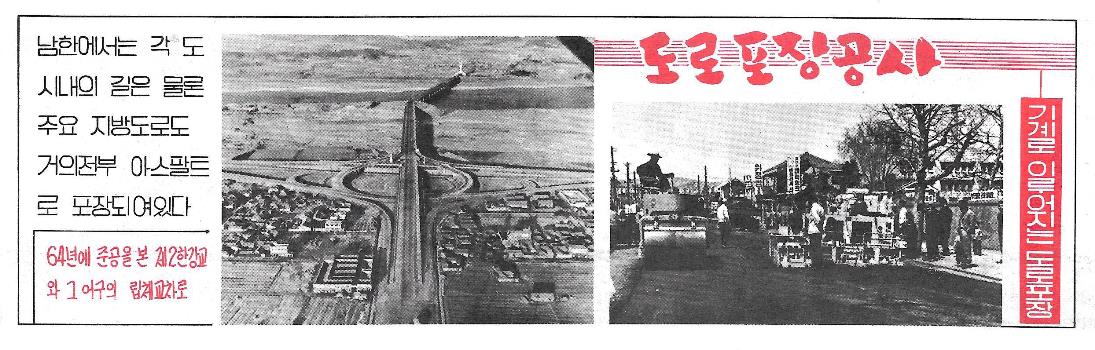
The issue of 10 June 1968 told of a 28-year-old North Korean military defector. He talked about leaflet 131 with the theme of road construction in the Republic of Korea. He said that in January 1967 his political officer brought a copy of this leaflet to a meeting and showed it to the audience. He went on to say that the picture was fake and fabricated from a drawing for propaganda purposes. Even though he had already stated that the roads were all fake, he went on to say that the roads were not built for the betterment of the people, but instead for war preparations. Everyone in the audience seemed to accept the story, but the defector thought there was something fishy about it. The text on this leaflet is:
Our Roads
Paving the country road of Kimhae-eub, in Kyungsangnam-do.
The continuing growth of road construction helps in the achievement of convenient transportation and helps the economy and the people’s livelihoods.
What Gifts should the Americans drop on North Korean Fisherman?
The Americans would question North Korean defectors to determine what gifts were most desirable. In 1966 a defector stated that the best gifts would be cigarette holders (fishermen’s hands are usually wet); cigarette lighters (The matches tend to get wet); nylon cord; sunglasses; cigarette cases (To keep the cigarettes dry) and ball-point pens (they are very expensive in North Korea). The same questions were asked again two years later by the Target Analysis Section of the 7th PSYOP Group. Items that might be placed in gift bags for North Korean fishermen were: electric light bulbs (the fishing boats always needed bulbs and they were scarce); Earmuffs for the cold winter days; Nylon string; Cigarette holders; and brooches for the fishermen’s wife who only have plastic jewelry. If floats were used, they should be thin, not too bulky and the contents should be clearly visible.
Leaflet 41
The 8 July 1968 issue described a 28-year-old female civilian who defected to South Korea in August 1967. She talked about the leaflet in the form of a 1 won banknote. She said that many children carried this leaflet with them, thinking it was a genuine North Korean one won note. Some children tried to buy candy at the cooperative farm store and the storekeeper scolded them severely, warning them that the leaflet was not money, but a South Korean leaflet on which poison was applied.
A former North Korea officer said about the banknote leaflet that it was so hard to distinguish from real North Korean money that it was occasionally used to purchase goods at stores.
A second defector said:
I saw the one won note safe conduct certificate at the Pantu Museum in Kaesong. I notice that some of the other visitors around me in the museum were also staring at it for some time, amazed at the nearly complete similarity between the one-won note on the leaflet and the real North Korean one-won note.
A third comment was:
I heard that a one-won note leaflet with a defector certificate on one side was receiving considerable attention from the public. On June 18th, I saw a warning about this leaflet posted on the bulletin board of the Social Safety Detachment. The warning read, "South Korea has spread leaflets similar to North Korean money in the Kaesong area. As a result, there seems a possibility of economic disorder. Those having leaflets in their possession are warned to report them without delay. Persons submitting leaflets will be rewarded with merchandize equivalent to the value of the money leaflets.
It was said that people who had reported these leaflets were rewarded with tobacco. About two days later, I heard that approximately thirty of the leaflets were found in a Kaesong department store when the store cashier totaled the day's receipts. I also heard that a Social Safety man used one of the leaflets to purchase cosmetics at the Cooperative Farm Store in order to determine whether the clerk would check the currency. When the saleswoman took the leaflet without checking it closely, the Social Safety man reprimanded her severely.
A fourth defector said:
I saw the North Korean one WON note leaflet at a meeting of the RI (lowest administrative division ranking below a township in the United States) cooperative farm Party Committee when a Social Safety officer showed a few copies of it to some members of the Committee and told them to gather up all such seditious leaflets, especially from children. I later found out that one of the copies of this leaflet had been turned in by a salesgirl serving at the RI cooperative farm store who received it as payment for a notebook sold to a child. The salesgirl was severely scolded for being late in reporting the leaflet.
Author’s Note: It is true that the front of the leaflet is close to the actual North Korean bank note, but all you had to do was turn it over and the entire back was covered with a South Korean flag and propaganda. It cannot be called a counterfeit. It is actually a propaganda parody of the banknote. 500,000 copies of this leaflet were dropped. The surrender message on the back of the banknote leaflet is:
To Soldiers of the People’s Army
This Republic of Korea safe conduct certificate [actually “certificate of security”] provides you with an opportunity for a new life. Bear in mind that your present toil will never change until the Communist regime collapses. Why should you give up your happiness? Please cross over to the South without hesitation. When you come to South Korea, this certificate will guarantee your personal safety when shown to any Republic of Korea or United Nations Command serviceman. We will warmly welcome you. You will be rewarded with money, employment, housing and freedom. Your safety is guaranteed with or without this leaflet.
(Signed) KIM Yong Bae, General, Republic of Korea Army, Chief of Staff
North Korean Actions when Leaflets were found
When South Korean leaflets first began to drop, high party officials launched a false propaganda campaign against them, claiming that the photographs shown in some leaflets had been taken in Japan or the United States merely for propaganda purposes. However, the propaganda had little effect on the North Korean people because they could see street and store signs written in the Hangul Korean alphabet and the women were wearing traditional Korean clothes on the streets. The North Koreans replied that the signs were fakes made just for the photographs. They pointed out that superior North Korean homes were prefabricated, while buildings in the south were made by piling one brick on top of another. With such a slow method, how could Seoul ever become a modern city? They said that all the people on the leaflets were good-looking and wore modern clothes so they must be movie actors. The North Korean Party officials soon realized that the people did not believe their counterpropaganda, and they became quiet.
Communist authorities were faced with a monumental task of denying people access to the leaflets after each leaflet drop. By using leaflets with unique aerodynamics, every individual leaflet mission covered several thousand square miles. The efforts made by authorities to police the leaflets are some indications that these authorities felt the leaflets would have some adverse effect on the people.
At absolute minimum, the introduction of massive quantities of leaflets forced the authorities to mobilize groups of people to police them up, taking them away from more productive endeavors or using up their own "free time" in a manner not of their own choosing. The following comments concerning specific incidents of police of leaflets in North Korea were made by former members of the target audience shortly after their departure from North Korea.
Defector 1 - "All available residents of the city were mobilized to remove the leaflets. Personnel of the Social Safety Bureau (police) became very upset when they discovered that village children were among the crowd picking up the fallen leaflets. Upon discovering this, the police mobilized their own force to pick up the leaflets and hurriedly removed the children from the area. It was my opinion that this was done because the Social Safety Bureau feared that children were highly impressionable and that they were more apt to talk openly about what they had seen. The Social Safety Bureau personnel were so upset because the residents had seen the leaflets that they called a special meeting of the area residents in the evening and discussed the leaflet problem at great length.
Defector 2 - "Many people were mobilized to police the leaflets, including about 60 men from my unit who were organized into four teams, each consisting of 15 men. These teams conducted the police in four different directions. I, myself, was assigned as officer in charge of one of the teams. All members of the Social Safety Detachment area, as well as many villagers, were also mobilized for this work. However, because of the terrain, the teams did not search the upper areas of the mountain. The policing details were confined to roadsides, village areas, and farms. Leaflets picked up by members of my team were all turned over to me. I instructed my men neither to read the leaflets nor to tear them up. Despite my instructions, I noticed many of my men examining the leaflets out of curiosity and looking surprised at seeing the photographs appearing on the leaflets. All details, including my team, were picked up approximately an armful of leaflets each. Had the search been extended over a larger area, a larger number of leaflets would have been found. All leaflets picked up by the detail were turned over to the political department of the base. Other leaflets picked up by the Social Safety Bureau members and by villagers were reported to the Social Safety Bureau of the city.
Defector 3 - "Sometime around 1700 hours in mid-September (of the first year), the students of the Kaesong City Agri-cultural Cadre Training School were required to gather on the school grounds. At this gathering, the chairman of the school's Socialist Labor Youth League, a teacher, informed the students that a large quantity of South Korean leaflets had been dropped in the Kaesong area and the Kaesong City Social Safety Bureau (police) had requested that students be mobilized to police the leaflets. The students were further informed that the policing of the leaflets would be supervised by members of the Social Safety Bureau Defense Unit. Led by the Defense Unit, the students went to the Kaesong Railroad Station square around 1720 hours, where students from the Kaesong Sajik Middle School and Kaesong City Party School had already gathered. At this square, the students were organized into groups of five and six, each led by a Defense Unit member.
The policing began at about 1800 hours near an orchard in the area and lasted approximately one hour. During this period, students collected a total of seven leaflets, some in the peach trees and some under the peach trees. Some students collected more than 10 leaflets, and some collected none. When the students picked up a leaflet, they gave it to the Defense Unit man. I did not hear the students discussing the contents of the leaflets, but I did hear them comment about the high quality of the paper used for the leaflets. [NOTE: An interesting, but not surprising, widespread reaction to leaflets has been the "high quality" paper used. The most common paper weight used is 16- or 40-pound bond. This paper is one grade lighter than normal bond typing paper. To a predominately rural target group and even urban dwellers exposed mostly to a low-grade pulp or newsprint type paper, the use of a high-quality bond paper to carry messages of economic, political and social progress and prosperity has drawn a favorable reaction.] After completing the police call, the students gathered in the Kaesong Railroad Station square again, around 7:30 p.m. At this gathering, I saw an officer of the Defense Unit holding three bundles of the leaflets that were picked up. He expressed his thanks to the students and then gave a talk which was intended to discredit the various leaflets found by the students."
The dictatorship in North Korea was eventually forced to answer the questions posed by the Jilli leaflets, and later began to copy their size, style and use of color in their own leaflets sent to the South. When Jilli leaflets depicted the Ulsan industrial complex, North Korea prepared a similar leaflet showing their own heavy industry. When Jilli leaflets spoke of the colleges and universities in the South, similar leaflets showing educational institutions like Kim Il-sung University were prepared by the North. The two nations dueled on subjects like railroads, with both pointing out their railroad transportation systems, but the Jilli leaflets also reminded the readers that in the South everyone was free to use the trains to go anywhere. Both sides produced leaflets showing the goods in their department stores.
Dave Underhill told me about the North Korean reaction to the Jilli leaflets. He said:
We had a Captain in Korea on temporary duty at the time, and I asked him to stop by 8th Army G-2 (Intelligence) and see if we were getting any reaction out of North Korea. He walked in, and was totally ignored as chaos reigned in the office. He waited a while and then said in a loud voice: “Are you guys getting any reaction out of North Korea?” He said you could have heard a pin drop. North Korea was on full military alert, and was moving troops. He left them content with the knowledge that the North Korean government was reacting to our leaflet drops and the movement was not an independent action on their own.
Jilli leaflet 120
The President Park Chung-hee leaflet was developed in Korea with the assistance of the Republic of Korea Army PSYOP staff. It was a New Year's greeting to the North printed under contract by Korean printers. In what might have been a case of sabotage (or just an error) Park’s signature line looked like the Korean word for “Rat.” The printer, as might be expected, was immediately arrested. The North Koreans had never seen a picture of Park. When their leaders depicted the president they used a caricature which was always highly uncomplimentary and associated him with all things evil. Project Jilli decided that the North Korean people should see an unbiased photograph of the southern leader and make their own decision about his honesty and integrity.
There is a long message on the back:
A Message to Our Countrymen
My dear fellow countrymen!
On this New Year’s Day, together with all the people of the nation, I bless all of you in the North. Last year domestically, our country in the South finished the first five year economic development project successfully bringing new prosperity to the nation. At the same time we opened a new Pacific era by convening many international conferences including the Asia-Pacific ministerial level meeting.
This is the fruit of our effort to pave the way for the national unification which has been the burning desire of the people in the South.
Our dear countrymen!
The people of the South, which is becoming a proud and blessed country, are preparing to liberate you from communist oppression in order to bring a second liberation to you. I ask you to overcome all hardships and press on with perseverance for unification and freedom.
God bless you.
President Park Chung-hee
1967Dave Underhill mentions a comment by a North Korean defector:
I had never seen a picture of President Park. I was anxious to see how the President looked. I learned from this leaflet that President Park was an intelligent and educated-looking person. I was impressed with the quality of paper used for the leaflet, and the clarity of the picture and printing.
Dave told me that not a single photograph of the President of the Republic of Korea had appeared in any North Korean publication. A highly uncomplimentary caricature of the President was always used which generally associated him with all things evil. Two examples were: An octopus with tentacles grasping the fruits of labor of the working people; a shark slicing through the waters slashing at various freedoms of the people. From the very beginning, North Korean propaganda had never mentioned the President without including a term of vituperation, which was used as if it were part of his name.
The response to the Park leaflet was so favorable that he decided to exploit the President and his wife, a former beauty queen. Later Jilli leaflets showed the President and his wife traveling abroad and being welcomed by various countries.
Kim Il-sung tried to have President Park assassinated several times. The 7th PSYOP Group kept notes on one of the assassination attempts. They state that on 13 January 1968, 31 members of the 124th Guerrilla Unit were ordered by Lieutenant General Kim Chung Tae to go to Seoul and cut off the head of President Park. They were honored to be given that mission and to liberate the desperate South Koreans who had invaded their country in 1950, lived in poverty, were regularly raped, beaten and murdered by the South Korean Army and the Americans, and were starving, having no jobs, food, clothing or electricity in their homes. By 17 January they were in Kaesong, where they were briefed by Colonel Lee Jae Hyung. They were told their route into South Korea, local guides who had cut the wires in advance, and divided into 6-man teams. They all received uniforms of the 26th ROK division as a disguise. Each man had a machine gun, a pistol, 300 rounds of ammunition and eight grenades. The final touch was a razor-sharp nine-inch dagger with which to cut off Park’s head. Their indoctrination caused them to make a major mistake. They ran into some woodcutters, but because they had been taught that the people in the South loved them as liberators and hated their own government, they let them live. The woodcutters immediately contacted the police. The teams split up and used different routes to Park’s “Blue House,” and were to meet for the attack at 2200. They ran into Army units that had been alerted of their presence and during the running gunfight that carried on all through the night, the guerrillas killed 26 ROK soldiers, Two American soldiers, two policemen, and eight civilians. 28 guerrillas were either killed in the battle or committed suicide by grenade to avoid capture as they had been told to do. Two disappeared into the woods and their bodies were never found. One guerrilla was captured, Lieutenant Kim Shim-jo who gave himself up claiming that after seeing well-dressed and well-fed South Koreans, their clothes, homes, shops and automobiles he realized that he had been lied to by Kim Il-sung. Lieutenant Kim later made propaganda broadcasts for the South pushing for the peaceful reunification of Korea.
Leaflet 144
Another item in the 8 July issue was in regard to the leaflet showing President Park and his wife on official visits to foreign countries. The people marveled at the fact that Park took his wife along and they said that it was correct for him to treat his wife as an equal and have her meet foreign dignitaries. They discussed the fact that other dignitaries took their wives along on trips and some female workers complained that their husbands never took them out even when he just went to visit his relatives or perhaps to some form of recreation. Some workers stated that they had never seen Kim Il-sung take his wife on any trips in the country or abroad and wondered why not.
Note: A comment by a 7th PSYOP officer at the end of this statement says:
Kim Il-sung now takes his wife with him and her picture now appears regularly in North Korean papers, probably as a reaction to this leaflet program.
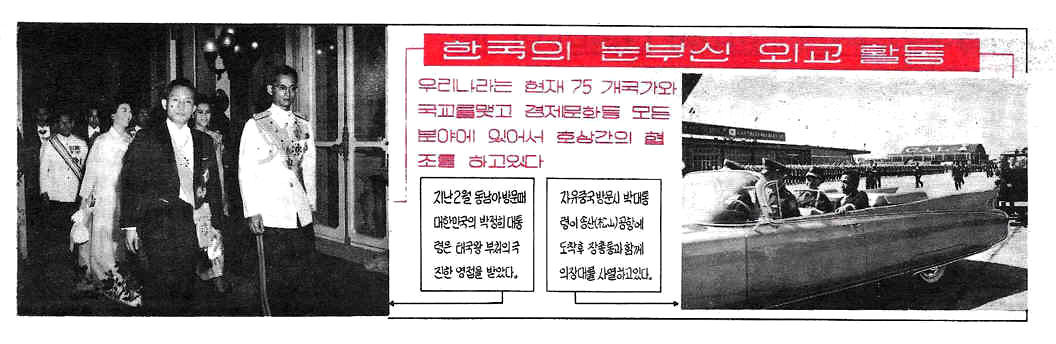
The front of this leaflet depicts Park in West Germany and Malaysia. The back of the leaflet depicts Park in Thailand and Taiwan. The text on the front is:
SOUTH KOREA’S DIPLOMACY, BASED ON FREEDOM, JUSTICE AND PROSPERITY
It has set a firm foundation for international trade, technology, cooperation and cultural advancement.
In 1964, President Park visited West Germany and agreed upon economic cooperation and strengthening the alliance between the two countries. Both countries Presidents and First Ladies attended a West German musical festival.
When President Park Jung-hee visited Malaysia in 1966, he was escorted by the nation’s King.
Leaflet 145
This leaflet also depicted President Park so the North Koreans were sure to be interested in it. The front depicts President Park and his wife in Thailand. The text is:
THE PRESIDENT OF THE REPUBLIC OF KOREA, AS THE CHIEF OF A FOREIGN STATE, RECEIVED THE GREATEST WELCOME IN THE HISTORY OF THAILAND
PEOPLES OF THE WORLD WANT PEACE AND PROSPERITY
The photograph captions are:
President Park receives Thailand’s highest medal from King Bhumibol Adulyadej.
President and Mrs. Park greet the nobility of Thailand at their reception.
Intelligence knew that the Republic of Korea had relationships with 75 nations while North Korea had relations with only 31. Communist propaganda claimed that the Republic of Korea’s foreign policy was only a puppet of the "U.S. Imperialism’s aggressive schemes." This leaflet was designed to show the North Koreans how the South had a much more dynamic relationship with the nations of the world than their own country did.
A panel of North Korean defectors was shown this leaflet and said:
This leaflet provide the people with an excellent opportunity to see what President Park actually look like; President Park is pictured in North Korean cartoons as an ugly dictator in uniform wearing black sunglasses. It will help the people realize the lies of the North Korean regime, and that South Korea is making a positive advance in international relationships and is enhancing its international prestige.
North Korean Agents liked South Korean Pop Songs
While in training, the spies listened to South Korean radio stations on Japanese transistor radios. They preferred to listen to pop music. They knew all the latest songs and the names of the singers. There were 25 agents in training at one base (all former criminals) and when they heard the South Korean pop songs they became sentimental. The songs sounded good and were easy for them to learn whereas the North Korean songs were stiff, used march tunes and were hard to learn. The South Korean songs were related to people’s daily lives while the North Korean songs had fighting themes which were not very interesting. The songs from the South reflected an enjoyment of daily life and were without political propaganda.
Leaflet 149
A third 8 July comment was on the celebration held by a South Korean couple. Many of the North Koreans stated that they would love to have such a celebration just once in their life. The political officers told the people that the girls dancing and the old couple holding their 60th birthday celebration were enemies of the people. The old couple was landlords or capitalists and the young girls were hired to dance at the celebration. The defector stated that not many of the women believed the Communist cadre.
A second comment by a former North Korean officer said the leaflet made a good impression to the elderly people of North Korea and showed the respect of the older people in the South. Such a party in the north was unthinkable because the work was so hard and the pay so poor that nobody had the time or money to put such an affair together.
A third comment was that in North Korea such a birthday party was out of the question since livelihood was difficult under the suppression of North Korean authorities. Although some old folks longed for South Korea, almost none of them thought of defecting because of their physical frailty and concerns for their family’s safety.
The North Korean propagandists stated that the South Koreans were poor and starving and there was no way such a party could happen. The text on the front and back is:
Korean Customs
In a free society beautiful and fine customs are preserved and bettered.
The girls of South Korea enjoy a folk dance on Thanksgiving Day.
Elder Choi is celebrating his 60th birthday jubilee.The back shows a young child at a celebration and asks:
Brothers in the North!
Are you allowed to enjoy the celebration of a first birthday, a wedding, or a 60th birthday jubilee like your brothers in the South?
We know very well that it is a fact that you cannot take part in the various celebrations like in the old days because you are without funds. Even if you had a modicum of savings to celebrate, you are not allowed to do so and you are not allowed to invite the people. In the South, no party or authority can meddle with your privacy.
BEER AS A PROPAGANDA THEME

Leaflet 178
This leaflet is all about beer. South Korea’s "OB Beer" won a gold medal in 1966 for the world’s best beer. They brag about that win. The leaflet has three photographs on the front and back showing the beer being made, beer machinery and barrels, people drinking the beer, and of course, the beer medal. The text on front is:
OUR COUNTRY’S BEER IS RATED NUMBER 1 IN THE WORLD
Kegs are filled with beer piped through the system.
The "OB Beer" was presented with a Letter of Award and a gold medal.
The "OB Beer" of the Republic of Korea won the coveted first place gold award at the 1966 International Food Quality Contest held in Brussels, Belgium. The Republic of Korea is the first country in Asia to win the award.
In South Korea, breweries including Chosun and Oriental breweries have modern facilities to produce large quantities of tasty beverages not only for the people of South Korea, but also as their contribution to the promotion of overseas export activity.
South Korean laborers are shown enjoying their beer at a local beer hall.
The text on the back of the leaflet is:
A scene of a brewery company’s laboratory. As a means of protecting the health of the people, all beer produced in the Republic of Korea is thoroughly examined and tested prior to the distribution to stores and restaurants for sale to the public.
Modern machinery is involved in the bottling and crating operation. Carefulness, caution, and strict inspection guarantee successful production of beer.
One defector was surprised to hear they made beer in the south: "I was surprised to learn from the leaflet on beer production that South Korea's OB beer had won a gold award as the world's best beer in an international contest. Since many North Korean people admitted South Korea's progress in light industries, this leaflet would be credible to North Koreans. In North Korea, beer was sold at restaurants and stores but was scarce. The only bottled beer available in North Korea was "Pyongyang Beer," which cost 1 won 55 chon in North Korean currency per bottle (NOTE: Several hours wages). "Pyongyang Beer" was also available for sale at stores where it was sold by the doi (a measure of volume); the price of beer sold by the doi was 1 won 10 chon per liter. To buy a doi of beer, one had to wait for one's turn in a line. Sold by the doi had a poor taste."
Defectors Select the Most Unpleasant Aspect of Life in North Korea
People were oppressed mentally and physically by excessive and incessant assignments from Communist authorities, assignments beyond the people’s capacity. Too heavily burdened by the main jobs and other additional activities assigned by the Party, the administrative organs, and other social circles, people had no leisure time of their own. You could be called at any time for “Social Labor.” This was cleaning streets, paving roads, construction, and harvesting during the farming season. Such activities could last from one to two weeks.
North Korea needs protein. Things were so bad in 1970 that Kim Il-sung ordered the Korean people to go fishing every chance they get. Kim then demanded more salt and pails to preserve the fish on their way to the market. In addition, everyone should be able to keep five chickens. North Korea apparently had about 10% of the meat, fish and vegetables it needs to give every citizen a healthy diet.
Leaflet 170
The issue of 9 July 1968 featured a 37-year-old Social Safety Captain who defected in August 1967 and remembered reading a leaflet in regard to a former North Korean agent marrying a South Korean woman. He said that leaflet created a great deal of envy among the North Korean people, especially the women, because they had never seen or been part of a wedding like the one depicted on the leaflet. The wedding scene made a lot of the women grieve over their own lives because they could not hold weddings as lovely as the South Korean women.
A 27-year-old former North Korean Captain who defected in August 1967 said about this leaflet:
This leaflet created strong envy among North Korean people, especially among young women, because they had neither seen nor held a wedding as shown on the leaflet since the Korean Liberation. Moreover, the leaflet showing the wedding made a lot of North Korean young women grieve over their own lives because they could not hold weddings as gorgeously as South Korean women.
The North Korean propagandists said regarding the wedding leaflet:
Such a wedding is a sheer impossibility for the apprehended North Korean agents as well as common people in the South Korean society.
S-15 civilian employee William 'Bill' Vaughan told me about the Korean weddings:
My wife & I lived in Embassy Housing on Yongsan South Post, 1996 to 1997. Our duplex was next to the (former) golf course, which had been turned into a city park. We were on a knoll, so we could see the daily activities in the park. We were amazed at all the wedding photo shoots. The brides were spectacularly dressed in colorful wedding dresses. We later learned that most of the wedding dresses were rented, perhaps from the photographers. It was most impressive. Pastel-colored dresses were popular during our time in Korea. I know fashions change, but we were fascinated by all the colors. Some were traditional white, but the majority were every color in the rainbow.
Party Interference with Marriage
Party members must check with their higher officials to get permission to marry. The Party screens the prospective spouses’ family background, and if it is found to be unfavorable, the Party official discourages the marriage.
North Korean propaganda occasionally seems to be saying two different things at once. For instance, in 1970 the government demanded that North Korean homes be neat and large, there be more restaurants and catering facilities, better consumer goods and more food. At the same time, they asked for austerity, frugality, and economization. Then they claimed there was plenty of food, clothing and shelter due to socialist superiority. The situation got so bad at one point that the government decided to industrialize the making of kimchi, a spicy cabbage dish loved by all Koreans. Kim Il-sung wanted all city residents to be able to get their kimchi.
Leaflet 5-65
A North Korean spy who came to South Korea in December 1967 and later turned himself in said about the textile leaflet: "The leaflet on the textile industry in South Korea was very impressive to me, and I believed that it would have been useful to other North Koreans because the leaflet theme indirectly exploited North Korean vulnerability, the lack of cloth and clothing. The text of the leaflet, however, was not concrete. The annual output of cloth in South Korea should have been indicated in the text. Such words as "In South Korea, everyone can freely purchase a suit for such and such a price in North Korean currency" should have been given so that the target audience might know how cheap cloth and clothing were in South Korea. Recently, in North Korea, a cloth made of the chemical fiber "Nitron" went on sale at stores but was so expensive (65 North Korean won per meter, or about one month's wages for a higher-than-average worker) and so rare that average people could hardly afford to buy it. Nylon materials were also expensive in North Korea. A nylon shirt cost 30 to 40 won. Usually, nylon shirts were out of stock at stores, so those who could afford to buy one had to make a purchase through a friendly storekeeper by paying installments in advance of receipt of the merchandise."
Did the leaflets work?
Defector 1 - "My decision to defect was made in May (of the second year) after my wife and mother died of sickness and I received a strict warning from the labor party committee which stated that I was considered disobeyed to the party due to my excessive absenteeism from political lectures and cell meetings. I was also told to make up a deficit of corn discovered missing from the Cooperative Farm Warehouse. On August 25, determined to defect, I visited my aunt's home located near the DMZ where I thought I would have a favorable chance to cross the DMZ. While in the vicinity of my aunt's home, I saw South Korean leaflets for the first time. I was favorably impressed by the leaflets, particularly those with scenes of streets in Seoul. The leaflets convinced me that I, too, could lead a happy life in such an environment and that I, therefore, should defect."Around 1930 hours, the next day, I left my aunt's home and proceeded south, determined to defect to South Korea. When I arrived close to the DMZ, I found three different leaflets spread out at approximately 4-meter intervals along a path. I picked them up and, identifying them as South Korean leaflets, put them in my pocket, and kept them until I came to South Korea."
Defector 2 - A former North Korean Navy lieutenant who defected 16 months after the leaflet program started stated: "I saw many leaflets on numerous occasions, and I often heard of other leaflet drops while living in North Korea. There were frequent leaflet drops where I lived, particularly since mid-May (of the second year). The Social Safety Bureau authorities in the area were troubled by the growing need for forming police-up measures to counter leaflet drops. As leaflet drops increased, the People's Pan (a group of houses) meetings were held more frequently to discuss this subject. The major topics discussed at these meetings were police-up measures and the possible influence of leaflet themes on the local population. I saw leaflets on many occasions, but I can't recall them all."
Defector 3 - I saw hundreds of copies of leaflets of more than 70 different types from about June (of the second year) until early November (of the fifth year) shortly before I defected to South Korea. During this period, I was on guard duty as an NCO in the North Korean Army just above the central part of the DMZ. On most occasions I was able to read completely the captions and texts of leaflets I found. Once I had to crumple up some leaflets and put them into a stove because I heard someone approaching."
Customs and Habits
The North Koreans like to chew but they don't have any chewing gum. The closest thing to it is a chewy candy they occasionally used which is made from vanilla and sugar which they call Kum (gum). North Korean Kum does not contain chicle, the chief ingredient of chewing gum.
The Intelligence Notes has vast files on North Korean foods; lists of what they like to eat and how to cook it and lists of what they don’t like. A farm worker who defected reported that the North Koreans would not eat dogs, snakes, frogs, crows, cats, rats and horses. However, dog meat was popular among some of the youth so they might eat in in secret during the summer because they thought it had a cooling effect on the body. The people also believed that Kim Il-sung loved dog meat. North Korea banned the people from making certain luxury foods or drinks from rice. The people would quietly break the law by occasionally making Takju (rice wine) or dansul (a sweet drink made from fermented rice) in the privacy of their homes.
North Koreans like tattoos and it is common for friends of the same sex to have the inside of their left arms tattooed to show lasting friendship. The Communists did not like the tattoos and regularly criticized those people that had them at team meetings, farmer's association meetings, and other group meetings. Tattooing was criticized as nepotism, putting personal relationships above those owed to society and the State, because such tattoos were a symbol of brotherhood or personal relationships.People having tattoos were asked to remove them; some were able to do so, others were not.
Ulsan Oil Refinery
Numerous leaflets mention this giant oil refinery so we have selected one that shows an excellent picture of it. The 7 June issue has a statement from a 36-year-old male who was a crewman on a North Korean spy boat and captured in April 1967. He said: “I accept the credibility of the leaflet. He knew about the existence of the refinery from North Korean radio broadcasts which asserted that it was being operated with foreign capital.
A 10 June 1968 issue features a 22-year-old North Korean private who defected in May 1967. He said that the leaflet was the chief topic of conversation among drivers in his unit who were instructed to be very careful with gasoline use because supplies were running short. Drivers received 165 grams of gasoline for every kilometer they drove. They were so desperate for oil that they were squeezing old oil rags. In 1965 the First Army Group announced with pride that 1.5 tons of oil had been salvaged from old rags that year alone. He added: “As far as I know there are no oil refineries in North Korea and all our oil comes from foreign countries including the Soviet Union. The text on the front and back of this leaflet is:
The symbol of Korea’s modern industrialization: the Ulsan oil refinery.
It is the ideal size for a refinery, 1,860,000 square meters and it produces 5,600 kiloliters of various types of oils every day.
The other side of the leaflet depicts and names of and various forms of transportation and oil products. The text is:
Liquid gas; oil for cars; oil for jets, cooking oil; oil for ships and oil for busses and trains.
Since establishment in 1963 in Gyeng-Sang-Nam-Do, the refinery has imported crude oil from foreign countries and has produced various kinds of oil and gas. Even today, new discoveries of crude oil are found and the cost is inexpensive but the expense of processing it is not. By construction the refinery in Ulsan, Korea is self-sufficient in its oil consumption, transportation and industry and exports the surplus.
Numerous defectors mentioned this leaflet:
1. I read the text repeatedly and became convinced that the claims about the Ulsan Refinery made in the leaflet were true and I further reasoned that if this was an indication of South Korea’s industrial potential, then South Korea must certainly possess a firm foundation for a self-supporting economy.
2. I accepted the leaflet on the Ulsan Oil Refinery as being true because I had some knowledge of the existence of an industrial Complex at Ulsan City in South Korea. I obtained this knowledge from a North Korean cartoon attacking the construction of an industrial center in the city. This was part of the Communist Party’s effort to counter the effects of the Ulsan Oil Refinery. I had read this in the monthly North Korean publication “Soldiers Literary Arts.” The cartoon contained in the publications stated in part, “People in Ulsan City come from every corner of South Korea to get a job. Upon arrival in the city, they are disappointed to find that they are unable to find work because of the limited places of employment there for them.” This leaflet convinced me that, unlike in North Korea where heavy industries were still a priority, South Korea was developing those industries directly necessary for the people’s daily life.
3.The leaflet on the oil refinery was dropped at an opportune time on my unit, and as a result created considerable favorable reaction to South Korea. The leaflet became the chief topic of talk among the drivers in my unit who were being strongly instructed to economize gasoline because the gasoline supply for military vehicles were running short. In my unit the drivers issued gasoline at the rate of no more than 165 grams for every one kilometer. At the time a campaign for economizing oil and gasoline will being stressed throughout the North Korean military establishment, and then the First Army Group authorities announced that because of the campaign, the quantity of oil obtained by squeezing it out of oil-stained rags for a year had reached nearly 1.5 tons in that Army Group. As far as I know, there is no oil refinery available in North Korea and oil is imported from foreign countries, including Soviet Russia.
Anti-Communist Groups in North Korea
There is at least one mention of a group of 21 men that formed an anti-Communist movement motivated by the leaflets in 1965. The group consisted of sons of past landlords, capitalists, religionists, those that favored the South in the Korean War, and others that were out of favor in the Communist regime. The group was eventually found and arrested in November 1967. They felt they were denied advancement in life under Communism and stated that their resolve was stimulated by leaflets and radio broadcasts from the South.
Leaflet 179
Although the North Korean population is aware of the large island off their coast called Cheju-do, they believe it is barren, uninhabited and the scene of past atrocities. In order to increase hatred of the South, the people are told that: there had been uprisings on the island and the South Koreans had massacred the people; The Island was abandoned and underdeveloped; and the few people that remained were impoverished and had been branded as insurgents and were closely watched. This leaflet was meant to show that in fact, the island was modern and thriving. This leaflet was developed in August 1966 to show the development of Cheju-do Island. Some of the general text on the leaflet is:
CHEJU-DO, the largest island of Korea, has become an outstanding INDUSTRIAL AND LIVESTOCK-RAISING AREA AS WELL AS TOURIST SITE
People of the South can travel to a recuperation center or a rest area at any time without any recommendation from their place of employment or from a political party
The captions on the three pictures below are:
Students of the Cheju Agricultural High School are shown cultivating subtropical plants.
The Cheju Agricultural High School is completely equipped with modern facilities to cultivate and produce subtropical fruits such as banana and pineapple.
Pigs grow to an enormous size because they are well cared for and kept in sanitary pens.
North Korean defectors shown this leaflet said:
This leaflet would shatter the fabricated myth regarding Cheju-do which the North Korean believe because of government propaganda. The photographs showing students cultivating pineapples and bananas will impress the North Korean people because they have never heard of such fruits being cultivated in Korea. They will realize that South Korean agricultural technology has made tremendous progress.
Leaflet 181
A third 9 July comment was on the subject of the leaflet that depicted a rubber shoe shop. The defector stated that this leaflet was very effective because it was dropped at a time when it was impossible to find rubber shoes in North Korea. The authorities actually ordered the suspension of the production of rubber tires in order to manufacture rubber shoes.
An American officer added:
This shows the benefit of using leaflets that are timely and based upon vulnerability in the target group.
CARTOONS – WE LOVE THEM, NOT SO GOOD AS LEAFLETS
Leaflet 22
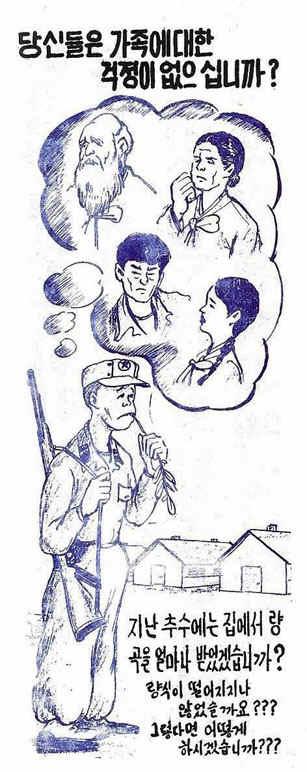
This cartoon leaflet depicts a North Korean soldier thinking about his family. The text is:
Are you concerned about your family?
How much grain do you think was given to your family last harvest?
Maybe it ran out already. If it did, what would you do?The back of the leaflet is all text:
It is a Korean tradition for the family members of a house to help each other.
What are you doing now for your family?There was a lot of criticism about the use of cartoons. Americans loved them. Many experts felt that they were not as powerful in changing attitudes as leaflets using photographs, especially color photographs.
Expert 1 - "Leaflet design and color, as well as content, should be given careful attention so that the North Koreans will be attracted by the leaflet and take greater interest.”
Expert 2 - "Because cartoon leaflets arouse little interest among the target audience and are sometimes incomprehensible to them, they should be avoided if possible. (NOTE: Ogilvy, a Madison Avenue millionaire, has this to say about illustrations: "Over and over again research has shown that photographs sell more than drawings. They attract more readers. They deliver more appetite appeal. They are better remembered. They pull more coupons. And they sell more merchandise. Photographs represent reality, whereas drawings represent fantasy, which is less believable.")
Expert 3 - "Photographs used in leaflets should be in color if at all possible."
Some Odd Intelligence Notes about North Korea
North Koreans show a desire for sexual intercourse by placing the index finger of the right hand up against the horizontal flat palm of the left hand or the thumb inserted between the index finger and the second finger of the other hand.
Five holidays are celebrated in North Vietnam, and 10 special days such as: Anti-Japanese Struggle Force Founding Day, Fatherland Liberation Society Founding day, and Anniversary of the Pochonbo Battle.
The Korean people have always had a high proclivity for bathing and personal cleanliness. It has been the custom of the Korean people to bathe in public bathing houses.
Some old men and women in North Korea still retain the knowledge about how to determine propitious and unlucky days from the lunar calendar. Some people will consult the old people before picking a day for a wedding or some other important event.

Leaflet 17-65
There were several leaflets that mention propaganda radios. This defector discussed the one that depicted South Korean radio facilities. He said that the leaflet was a great help to him in selecting South Korean radio frequencies. He suggested that the South Korean news program schedules should have also been supplied in the leaflet.
Author’s Note: In North Korea the owner of a radio takes it to the local post office where it is tuned to a North Korean station, and then “fixed” so that the station cannot be changed. It is rumored that some handy radio owners have found ways of tampering with the “fix,” so that they could tune to radio stations in the south. The text above and below the Communist radio without a tuning dial is:
Does everyone get to hear the station they want to hear? Do you want to listen to South Korea? What if everyone who wanted to listen to the radio station were not able to ...
What is the dial on the radio for?
The text on the side showing the western-style radio with a tuning dial gives the various frequencies of South Korean radio stations:
These are the stations available in South Korea.
(A list of 10 AM, FM and shortwave stations follow in either two or three vertical columns)
Is everyone able to listen to any of the stations?
One defector commented on radio leaflets: "The leaflet listing South Korean radio frequencies was a great help to me in selecting South Korean radio frequencies. However, South Korean radio news program schedules should also have been supplied in the leaflet."
What Happens after the Leaflets are Dropped?
The clean-up and collection of the Jilli leaflets was usually the responsibility of the Red Guard (militia) members who would order the local children to pick up the leaflets. The leaflets were then sent to the local Social Safety Detachment, which conducted research and analysis on where the leaflets were dropped, the people’s reaction, etc. Three copies of the leaflet were then forwarded to the County Social Safety Department and the rest burnt at the end of the year. The people’s reaction to the leaflets was also sought through informers. Every local area had about 50 informers selected by the Social Safety Detachments.
This has been a very short look at some of the Intelligence reports gathered by the 7th PSYOP Group during their top secret Jilli operation against North Korea. It is meant to be just a “taste” of what was going on during the Cold War. The reader must remember at the same time these aircraft were dropping Jilli leaflets the Vietnam War was going on. A C-130 Hercules that dropped leaflets over North Vietnam today might be assigned to drop them over North Korea tomorrow.
Leaflet 161 – Woman’s Personal Care
This leaflet depicts women in South Korea in a beauty parlor on one side and in a tea house on the other. The text on the front is:
A beauty parlor for the women of South Korea. The photo is taken in Chongju City
A PSYOP panel studied this leaflet and decided:
The female population of North Korea represents a specific target audience for the Operation Jilli leaflet program. For the past few years western influences have gradually gained ground in the north, particularly in connection with woman’s clothing and hair styles. This leaflet is designed to display some affluent aspects of South Korean women’s clothing and hair styles. Women shown in this photograph are well dressed and their hair styles are charming.
A North Korean agent who saw this leaflet before he came south and turned himself in said about it:
I realized that the South Koreans attached importance to personal services and that they were enjoying the benefits of the personal services in every field. The leaflet should have depicted in detail how the barber shops, beauty shops, tailor shops and so forth in South Korea gave personal services to patrons. There are many vulnerabilities in personal services in North Korea and they should be exploited in the leaflets.
How to Improve Jilli Leaflets
The Intelligence report had certain suggestion for the betterment of the leaflets. Lieutenant Colonel Underhill added his suggestions to them (in italics).
Hackneyed and repetitive contents should be avoided and up-to-date contents be used to create a more favorable reaction among the target audience. Lead time due to seasonable winds can be nearly one year for many leaflets.
The daily life of South Korean people, which the North Korean people are most anxious to know, should be described in detail. Almost all of the defectors made this statement.
Because cartoon leaflets arouse little interest among the target audience and sometimes are incomprehensible to them, they should be avoided if possible. Almost no cartoons are printed now. Many were used early but this same comment over and over by defectors resulted in their elimination.
Photographs used in leaflets should be in color if possible. Almost 5% of all leaflets are now in color.
The contents of leaflets should be seasonable and timely in accordance with patterns of rural North Korean life because most leaflets fall in rural areas in North Korea. This is already being done. Most leaflets are now 6 x 2.4-inches because of aircraft flight restrictions. Aircraft must fly south of Seoul.
The Recommendations of North Korean Defector on how to improve Jilli leaflets
The 7th PSYOP Group found a very talkative North Korean defector who is identified as a male who graduated from a North Korean agricultural college, was a former member of a North Korean economic planning unit, came to the Republic of Korea in July 1969. The source reported that while in North Korea he had seen some leaflets from the Republic of Korea. Based upon his experience with them, he made several recommendations:
According to the source, in leaflet operations, as in radio broadcasting operations, three key points should always be considered: theme selection, credibility, and repetition and continuity in the dissemination of the message.
A leaflet should be simple and clear about message. The text should not be long and small letters should not be used because then the leaflet cannot be read easily and quickly. If a leaflet is simple and clear, the person who picks up the leaflet should be able to catch the message and outline immediately.
In North Korea, farmers and workers are enjoying some benefits—employment, education for their children, and welfare. Therefore, they consider that their lot is now better than it would be under a capitalist society. They do not think that changing to a capitalist society would benefit them. The source recommended that leaflets convey messages to them to allay any fears they might have about living under a capitalist society and to show them that their circumstances would be improved.
When taking photographs for leaflets, care should be taken in selecting sites to be photographed that demonstrate real benefits to the people, rather than producing just a pretty picture.
North Korea emphasizes its education system in its propaganda; vulnerabilities should be found in North Korean education. Then leaflets can be prepared based upon these identified North Korean vulnerabilities, which emphasize the strong points on these specific topics in the ROK educational system.
North Korea continually emphasizes that life is better in North Korea than in the ROK; however, on closer scrutiny of both, it will be found that in the ROK things are generally superior to North Korea. The treatment of dead soldiers is an example of this fallacy. They are buried in unmarked graves on the battlefield; only high-ranking North Koreans are honored with tombs. In the ROK, however, those who die in the defense of their country, regardless of rank, are buried and honored by all at the national cemetery.
The source considered that for leaflets the following two themes were important: basic living conditions (food, clothing, and housing) of average people in the ROK; and social welfare, cultural, and material benefits of life in the ROK.
Regarding leaflet preparation, the source recommended that the best quality of paper be used. This will reinforce the idea of a prosperous paper industry in the ROK. Also, paper should be used that is durable so that the leaflet can be read even though exposed to the elements. Printing and photo reproduction should be clear. Color leaflets are preferable to black and white leaflets to attract the attention and interest of the target audience. Use short texts and an abundance of photos. He suggested the use of photos with clear captions so that the meaning or message of the text can be caught immediately. Pamphlets printed on good paper with many color photos would make positive impressions.
Source recommended that special leaflets be prepared for use against North Korean soldiers. The upper half of the leaflet could have a calendar, photos of female Korean movie stars, or photos of nude females. The lower half of the leaflet could contain the PSYOP message. Then the leaflet could be cut in half and the photos or calendar retained by the soldier, and the message disposed of after being read. Most young soldiers, while in the army, did not have much chance to see or be with girls, but they did think about them a lot. Therefore, they would especially welcome color photos of the faces of Korean girls and nude color photos.
The source said that North Korean soldiers learned the words of Korean popular songs by hearing them over ROK DMZ loudspeaker broadcasts. The use of printed versions of those songs on leaflets for North Korean soldiers near the DMZ would reinforce this.
The source considered the best time for disseminating leaflets to be at night, preferably after midnight and before dawn, so that the leaflets could not be seen falling to the ground.
He suggested that leaflets be disseminated to areas of moderate population density where the person who found the leaflet would have a reasonable chance of reading the leaflet unobserved.
As we approach the end of this report, I think it might be pertinent to mention the Naval Postgraduate School thesis titled, PSYOP in Stabilization and Reconstruction Operations: Preparing for Korean Reunification by Jeremy S. Mushtare in March 2005.
Countering Operation Jilli
The propaganda war did not end with the signing of the armistice. The North Koreans continued to engage in several operations that attempted to subvert operations in the south. The United States and the Republic of Korea continued to disseminate leaflets and conduct radio broadcasts for several years. Operation Jilli was one such leaflet program conducted by U.S. psychological operations units in the mid-1960s. Radio broadcasts continued to be of little use to the U.S. PSYOP forces due to the low availability of radios among the North Korean people. Though the North Koreans possessed a high literacy rate, the United States was unable to exploit this characteristic because the dissemination of leaflets via leaflet artillery shell or leaflet bomb would constitute a breach of the armistice agreement.
Thus, the U.S. PSYOP units began employing leaflet balloons both to circumvent the explicit proscriptions set forth in the armistice agreement and to inject truth into the information-deprived North Korean populace. The first such mission took place in 1964 and resulted in the dissemination of millions of leaflets into North Korea. While the North Koreans had employed leaflet balloons for several years, their operations were not nearly of the scale of those launched in execution of Operation Jilli. Interviews were conducted with North Korean defectors to determine the effectiveness of these U.S. PSYOP products. The "respondents were also unanimous in their opinion that the North Korean Communists are now forced to reevaluate their existing internal political indoctrination of the people and their propaganda output directed at the South Korean audience, to cope with the constant pressure applied by Operation Jilli."
Consequently, the North Korean regime was forced to undertake substantial counterpropaganda techniques to mitigate the effects of Operation Jilli. Such techniques included the mass gathering of leaflets for incineration followed by speeches refuting the leaflets’ themes. Further, the PSYOP analysts noted that, "The success of the Jilli program has been underscored by the use of Jilli themes and techniques by the North Koreans in their own leaflet dissemination program." Also, analyses of the North Korean Labor Party newspaper over a ten-month period have revealed a four to five-fold increase in what can be interpreted as counter-Operation Jilli, pro-North Korea, propaganda (specifically, in newspapers three months prior to, and seven months following, the start of Jilli leaflet drops). Hence, the conduct of Operation Jilli appeared inadvertently to help North Korea hone their own leaflet efforts as their styles and themes soon began to coincide with the basic principles used in producing leaflets for Operation Jilli.
Some Computations
The first leaflets were dropped on 30 June 1964 from a C-47 aircraft. The larger C-130 aircraft was introduced in 1965. When the Jilli leaflets were dropped in extra large quantities, the density of leaflets was about one leaflet every 20 meters. A C-130 load of 10 million leaflets would cover 1,900 square miles. Most missions covered 4,000 to 6,000 square miles and one mission covered 18,000 square miles. It is assumed on these regular missions one leaflet would be found per 400 square meters.
Conclusions
The success of any strategic psychological leaflet campaign is not based on the sensational but on the wearing away of established beliefs and replacing them with new ones. The change in beliefs is not brought about by "hard-hitting" messages with obvious, tremendous impact but the "down-to-earth" common sense approach to common, everyday affairs that the target audience can identify with.
A simple photograph of a student wearing a watch draws a feeling of envy; a picture of the President with a sympathetic message transmits a "warm" feeling; a picture of a girl in national dress is cut out and kept in a wallet; photographs of meat-cutting machines and refrigerated meat displays are found interesting because the target member has never seen them before, even though he was formerly from the area; beauty shop scenes are found attractive and impressive because they are not common within the target area.
The psychological operations personnel engaged in leaflet planning and development should take a long, hard look at every aspect of the message as it relates to the target audience. The sensational element should be eliminated from the program. The program should consist of an honest presentation of conditions within the Free World (and of a given country, if applicable), being selective to present the favorable aspects that relate to the target audience regardless of how remote the relationship might be.
Because in a strategic leaflet operation all members of the population have access to the message, it must not appeal to one segment of the audience at the expense of another. It must never be more than neutral or of disinterest to any one segment of the general target audience. A shotgun approach with many leaflet titles on many different subjects must be disseminated if any substantial change in belief is to occur. A major factor in the success of a strategic leaflet program will be the presentation of a wide variety of themes with several different approaches or leaflets on each theme.
Readers with questions or comments on the above article are encouraged to contact the author at sgmbert@hotmail.com.