The above leaflet attempted to place guilt on the soldier for abandoning
his woman for the war. The leaflet depicted a woman lying in bed clutching a picture of
her man. The leaflet reads:
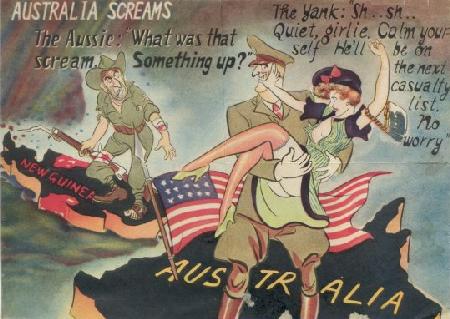
The above leaflet attempted to persuade the Australian "Diggers"
to abandon New Guinea and go home because their real threat were the American soldiers, to
include black soldiers, staged in Australia who were seducing the Australian women while
they were dying in the jungle. The leaflet depicts an American soldier kissing an
Australian wife while dead bodies are shown in the foreground and background. Just in
case the finder is not too smart, notice that the Japanese have placed little American
flags on the back of the soldier and on his hat. The text is:
Still another leaflet played on the theme that any defense of New Guinea
was hopeless and for nothing. Why die for a jungle. The 7-inch by 5-inch Japanese
leaflet depicts a dead Australian soldier chained to the island of New Guinea holding a
citation from U.S. General Douglas MacArthur. The text reads:
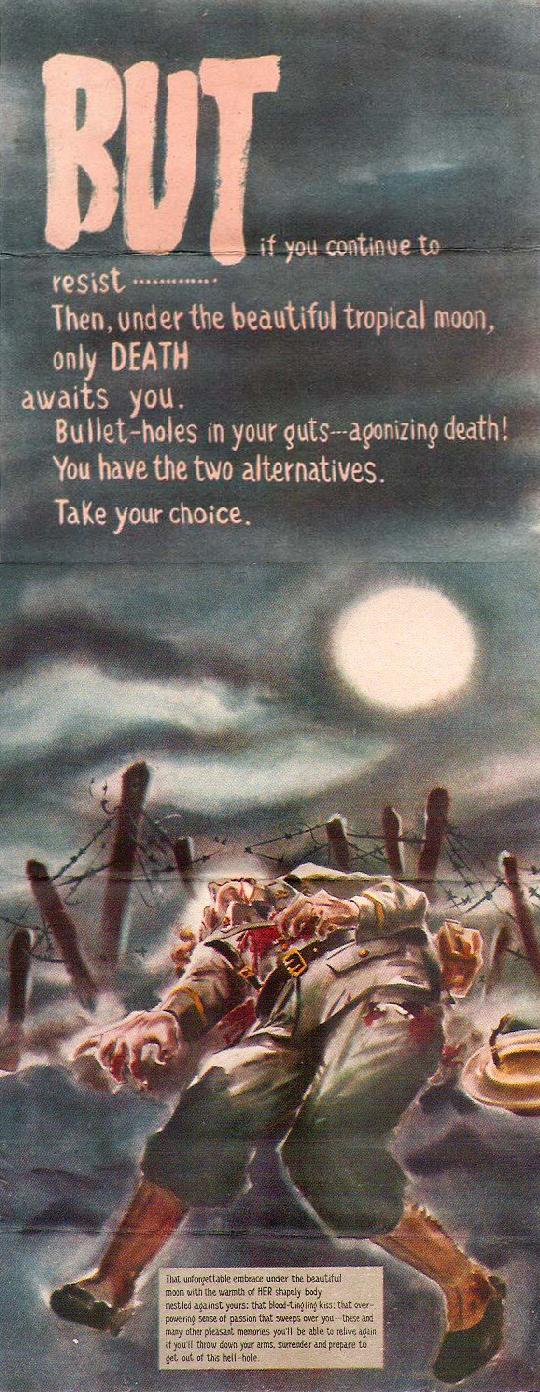
Sometimes the Japanese used sexual images in order to influence Allied soldiers to
pick up surrender leaflets. The leaflet above depicts a bare-breasted female in an
inviting pose. The English-language text is text is:
This leaflet was mailed to by an Australian airman to his father at home. He wrote on
the back:
Dear Dad,
I am sending you this Jap propaganda leaflet. The Nips often drop these, but of
course we know about all these promises of his. I received your letter and will answer it
during the week.
Your loving son
John

The Japanese Propaganda Movie “Calling Australia.”
The Japanese are known to have made on very interesting propaganda movie for use
against the Australians. The movie used Australian prisoners-of-war and it is unsure if
they took part voluntarily or under duress. The movies shows all the prisoners in clean,
starched uniforms, eating hot meals in recreation clubs, drinking various beers and
liquors, being paid a monthly stipend and even swimming in a country-club style pool. It
is an amazing propaganda piece. Considering that something like 27% of Japanese POWs did
not survive the war, I doubt that many Australians were fooled by this motion picture.
Prisoners of war from Australia held by the Japanese were subject to murder, beatings,
summary punishment, brutal treatment, forced labor, medical experimentation, starvation
rations and poor medical treatment. No access to the POWs was provided to the
International Red Cross.

Japanese Leaflet to the Local Natives
Americans tend to think of the Japanese soldiers as tyrannical and inhumane.
However, in some cases they seem to have treated the locals better than their former white
masters, paying them a fair wage and giving them limited freedom. There seem to have been
some cases where the tribesmen actually felt a loyalty to the Japanese. One individual who
knows the Papuans well said in regard to this leaflet:
The Japanese occupiers of northern Papua / New Guinea were, for the most part,
liked by the Papuans. In general, the Japanese hired the Papuans to work for them;
teaching them to drive trucks, perform rudimentary maintenance on vehicles and equipment,
etc. and paying wages in the occupation currency. Better treatment than they received from
their pre-war Australian administrators. From the Papuans' point of view, they just
changed one occupier for another.
In this Papua / New Guinea Pidgin-language leaflet the Japanese encourage the
natives to report on the whereabouts of any Allied troops. The leaflet depicts two natives
standing on a hill above American troops making an amphibious landing on their island. One
comments on the foolishness of the Americans and the second native points and tells him to
run and tell the Japanese troops. Text on the front of this very colorful leaflet is:
GO QUICKLY AND TELL THE JAPANESE SOLDIERS
Oh! The American soldiers are very dumb! They don’t know that
the strong Japanese soldiers will kill them.
Hello! Run quickly and tell the Japanese soldiers. The Japanese soldiers
are there!
We read more of the Japanese techniques in New Guinea in War by Stealth: Australians and the Allied
Intelligence Bureau, Alan Powell, Melbourne University Press, 1996:
Japanese propaganda was very extensive in this district during their occupation
and seems to be rather effective. Natives were told that the war started because Japan and
Germany and native (spirit) ancestors were sending goods to New Guinea and the English
would not let them get through.
Japan and Germany would win the war and then would kill all
the English in New Guinea and any natives who helped them…Natives who helped Japan
would be well cared for and paid well at the end of the war.
The Japanese preyed on the members of the Cargo Cult (who prepared airfields for the
coming of the aircraft bringing treasure to the natives) and called on the spirits to help
their war effort. An Australian sergeant added:
The enemy staged singings and during the proceedings they would kill a pig, cut
it down the center, and then eat the right side. The left side would be left in the sun
until it rotted. This side represented the Australians who were not strong enough to win.
Other Campaigns
The Japanese also dropped leaflets on Burma, Thailand and Indochina. These campaigns
were not as extensive as those mentioned above and in most cases the leaflets were more
plain, either black and white or a dull monotone.

Burma Monster Leaflet
An obvious exception to my description of "dull" leaflets are those for
Burma. They are quite colorful. Some leaflets show the British as monsters. One dropped
over Burma depicts a green toothed demon wearing a Union Jack devouring Burmese civilians.
The text is:
The British Monster and Us

Burmese attack leaflet
Another shows a Burmese leader on horseback attacking British troops. In this case
the flag they carry was a Japanese sponsored organization that allegedly wanted to revive
the Burmese monarchy. A very similar image was used on a leaflet to the Indians. The text
is:
Join the Revolutionary Army to rout out the British

This Man is Foolish
The leaflets to Indochina are written in French and depict images such as a lone French
officer looking at swarms of Japanese bombers and tanks on the horizon with the text:
Those who think of resisting the Japanese would be foolish!

This Woman Wishes
Another depicts a wife and children trying to pull a French soldier away from a
battlefield covered with skeletons with the text:
This woman wishes that you live.
Another leaflet is in the form of a hand-written letter and entitled in French
"Proclamation of the Japanese Army in Indochina." Other leaflets teach the
French and the colonial troops how to surrender by using a white flag, and one contains a
safe conduct pass from the Supreme Commander of the Japanese Army.

Safe Conduct Pass
Another safe conduct pass shows a classic nude on the back. The text is standard,
telling the finder that he may use the pass to go over safely to the Japanese Army.
Some of the leaflets picture wartime photographs of Japanese bombers with the text,
"Japanese bombers over Indochina! Do you know what they will do to you? In another
leaflet, the bombing of Chungking, China is depicted. One long horizontal leaflet depicts
five beautiful women on one side, and five scenes of Japanese military might on the other
with the title "Impossible to Resist."

Malaya Leaflet
Japanese Black Propaganda to Malaya
The Japanese swept across Malaya quickly after their 8 December 1941 invasion,
moving through what was thought to be impassable jungle. In this leaflet that the finder
has dated 5 February 1942, the Japanese tell the Empire soldiers that British and
Australian soldiers are secretly leaving Singapore while the people riot. It warns the
Malayan and Indian soldiers that they will soon be alone and encourages them to cooperate
with the Japanese. The leaflet was air-dropped over Selarang Barracks in Changi after
a bombing raid.

Special
Order
Benjamin Seet, the
premier collector, and researcher on Malayan PSYOP allowed me to add this
leaflet to this article. The “Special Order” from General
Wavell instructed Allied troops to lay down their arms, as peace terms with
Japan had concluded. It was dropped on the Malayan side of the Causeway.
This was black propaganda deployed to take advantage of disrupted
communication lines of the retreating Allies. The simple layout of the order
betrays its nature, and it predates the actual surrender by 5 days. A 1942
example of fake news!
Lieutenant General Arthur Percival, Commander of Allied forces in
Singapore surrendered about 130,000 Allied troops to the Japanese on 15 February 1942. The
fall of Singapore was the largest surrender in British military history.

We shoot at the enemy
This strange Japanese leaflet to the Malays shows a Polish soldier (one assumes a
“Free Pole” who fled to Britain after his nation fell), forcing a tearful
Malayan to attack the Japanese. Notice that the soldier holds a semi-naked Malay woman
under his left arm. The Japanese carefully shoot at the Pole with rifles, artillery and
aircraft. They are trying to show that if a Malayan is hit it is purely by accident. The
text is:
The Polish army claims to support you, but instead is your enemy.
We will be shooting only at the enemy

England and America…
This leaflet would appear to be for India since it has the message in Hindi and
Bengali. It depicts Japanese fighter-bombers attacking land and sea targets as Churchill
weeps at the top and Roosevelt weeps at the bottom. The text is:
Malaya
England and America are finished
Air [Power?]

Hong Kong Leaflet
A Japanese leaflet dropped on Hong Kong depicts crossed rifles bearing the flags of
Japan and China over a table set with drinks and glasses. The Chinese text is:
FOR BETTER FOR WORSE. It is essential that the relationship between China and Japan
must grow closer because of the war in East Asia. The victorious results of Imperial Japan
will be advantageous to China and provide her with prosperity and happiness. Chinese and
Japanese should be like brothers and sister and should join together to understand each
other and work towards the future prosperity of East Asia. Do remember the date; December
8th. JAPANESE ARMY
English text on the back is:
British Officers and men! What do you expect in your useless resistance after
having been cornered in this small island of Hong Kong? If you are waiting for the
Chungking troops to stir up the Japanese rear, it will only end in a fool’s dream,
the Malay Peninsula and the Philippines are now under the way of the Japanese Forces and
their fate is completely sealed. Your comrades brought to Kowloon, have already been to
Samchun and they are calmly enjoying a peaceful Xmas. You are at the crossroads now.
It’s all up to you whether you prefer death or save your life for the future. We will
give you the last chance for your reconsideration, if you surrender to us, the ultimatum
ends at the midnight of Dec. 26. JAPANESE ARMY.

Stop Useless Resistance
Another Japanese leaflet for Hong Kong, this one aimed solely at the British. A
Japanese bomb drops toward a lone British soldier and the text that says in part:
When the Japanese force makes it attack, Hongkong cannot be escaped from the most
fierce bombardment by the Japanese Air Armada. Even with no aid from the land force, it is
certain that Hongkong will be smashed into pieces from the air. British officers, we
appeal you to consider the very fact. Do not kill your men in meaningless resistance!

Wolf Boy
A colorful Japanese leaflet was dropped on the Chinese troops allied with the
British. It shows a wolf-faced British soldier leading a Chinese soldier to a cliff where
he will surely fall off and into massed Japanese bayonets depicted below. The text on the
front is:
Do you really want to sell your soul to the British white ghost and see the Liao
Zhai tragedy befall you?
Why does the British soldier have the face of a wolf? In China the wolf represented
rapacity and greed or an official who exacted money unfairly from the people in the shape
of unauthorized taxation. In fact, Chinese propaganda sometimes showed the Japanese as
wolves. The term “white Ghost” was an insult used for Caucasians. The Liao Zhai
tragedy relates to famous tales from Chinese history and can be translated to
“Strange stories from the Chinese Studio.” This is a collection of nearly five
hundred mostly supernatural tales published during the early Qing Dynasty. These tales are
about being deceived or led to death in some way. The Japanese seemed to have done their
homework here and this would appear to be an excellent propaganda leaflet.
The back of the leaflet is all text. The first two columns say that anyone who
surrenders with the leaflet will not be treated as a captive but as an ally. He will also
be given cash in exchange for working for the Japanese. The leaflet then explains how it
is to be used. It is not necessary for each person to have a leaflet; a group may
surrender with one leaflet. When approaching, wave a white flag, hold your hands high, and
have any guns pointing downwards. Hand over the leaflet to the Japanese. If you have
killed a British or American soldier who had some documents, you will get promotion to a
high office in the newly formed government. The leaflet is signed by the Japanese
Commanding General and there is a section that gives instructions to the Japanese soldiers
who are handed the leaflet.

Cooperation with Japan
This amazing leaflet looks almost like a gambling den. My translator suspects it was
used in one of the old British colonies like Hong Kong or Singapore. Chinese are seen
gathering around a Japanese business where the money flows like water. To their left is a
boarded up British establishment with perhaps Churchill on the balcony doing no business
at all. The text tells the Chinese that working with Japan will make them wealthy, staying
with England will make them poor. The text is:
Cooperate with England and you’ll lose all your money
Cooperate with Japan now and make a fortune
The power of England in East Asia has completely collapsed
English goods trading company
Pro-Japanese store
Japanese goods
Make fortune by cooperating with Japan

Chun Gui’s Dream
I love this Japanese leaflet to the Chinese because it reminds me of other leaflets.
At the top we see soldiers dead in the barbed wire. The Germans produced similar leaflets
for the French showing both French and American soldiers dead in the wire. To the left of
the Chinese soldier is a question mark. In Vietnam the United States produced a very
similar leaflet coded Q-237 showing a Viet Cong wondering about the war with a large
question mark to his right. This leaflet and the one following both seem to have been used
in the same place; Guangdong province. The text on the front appears to be a parody of an
old Tang dynasty poem:
Pitiful bones by the river on Yunnan’s frontier - Just like
the man in Chun Gui’s dream.
This refers to an ancient story about a woman whose newlywed husband was drafted
into the forces of a warlord. She dreamed that he had died in battle. The site of the
scene (Yunnan’s border) indicates that in both cases the leaflets were aimed at
soldiers drafted from Guangdong province for fighting in the south. The back of the
leaflet has directions for surrender, offering to let the holder either enroll in the army
of the "ew China" (the Japanese puppet state in Nanjing) or return home to
Guangdong. Those who have killed American, British, or Chiang Kai-shek troops are offered
favorable terms, as is also the case with anyone carrying important documents when they
defect. There is also Japanese text at the back left instructing Japanese troops to
respect the terms of surrender.

No Sooner has one of us Fallen…
This Japanese leaflet clearly shows the Chinese soldiers that the British see them
as nothing better than shields to be used as protection against Japanese fire. The British
soldier hides behind the bodies of two dead Chinese soldiers. He lives as the soldiers are
shot to pieces. The text on the front is:
No sooner has one of us fallen than another enters the breach!
The leaflet targets men from the Guangdong provincial fishing villages who had been
drafted into the Republican forces. The image implies that they are dying like flies for
the sake of the foreigners. As in the leaflet above, the back of the leaflet has
directions for surrender, offering to let the holder either enroll in the army of the
"New China" or return home to Guangdong.

Hankou is Rioting
This strange Japanese leaflet to the Chinese depicts Chang Kai-shek fleeing
with stolen money while the Japanese citizens of Hankou are beaten and killed by members
of the Chinese Revolutionary Army. The text is:
The Chang Kai-shek government is completely collapsing
Chang Kai-shek is fleeing with bribe money
Hankou is rioting
Refugees are flooding into Wuhan. Huang’s army is robbing
refugees. All of Hankou has become Hell.
This leaflet might be in reference to the Hankou (AKA Hankow) Incident. It occurred
on 3 April 1927 when the National Revolutionary Army of China invaded the Japanese
concession in Hankou, engaged in vandalism and looting, and attacked Japanese residents
and consular staff. Some reports suggest that the incident occurred at the instigation of
the Chinese Communist Party; however the riots were initially sparked by an altercation
between Japanese marines and Chinese workers. The Japanese would seem to be claiming that
they were the injured party and justify their invasion and occupation of much of
China. General Huang Xing was a Chinese revolutionary leader and statesman, and the
first army commander-in-chief of the Republic of China.

Chang Kai-shek’s wish
The second leaflet of this trio is a bit more colorful but I believe it is also from
the same artist. Once again it mentions Hankou and it seems to be a “divide and
conquer" leaflet. Chang Kai-shek is at the center with a whip. He apparently wants to
bring all the Chinese military under his control. At the left we see his happy Central
Army smiling and eating. At the right he sacrifices the local armies and sends them to the
front to fight the Japanese. The text on the leaflet is:
Chang Kai-shek’s wish – Keep the Central Army – Reform
the Local Armies
To his troops:
You can have a fulfilling meal. The local armies will be wiped out by the Japanese
soon. Let’s prepare to leave Hankou quickly.
To the local armies:
Go! You must hold the line to the death or face the firing squad.
This sort of divide and conquer leaflet is quite common. In WWII we told the German
Army that Himmler’s Waffen SS was better treated and better armed. In the
Korea War we told the North Koreans that the Chinese were using them as cannon fodder. We
told the Serbian Army that they were being besmirched and their reputation smeared by the
actions of the Interior Ministry Police. Here the Japanese attempt to split the Chinese
forces by telling them that the Central Army sits and rests while the local forces are
killed.

Bai Chongxi
This leaflet appears to be from the same artist that did the one above. Bai Chongxi
was a Muslim general who had a tumultuous relationship with Chiang Kai-shek but ended up a
powerful figure in the post-1949 government on Taiwan. He had apparently fought Chiang
during the 1930s and then sided with him during the war with Japan. Perhaps the Japanese
were courting the friendship of the Muslims. It seems they were working on a “divide
and conquer” strategy with this leaflet. It features a Muslim Kuomintang general (Bai
Chongxi), with the support of Muslims and regional military heads, fighting Chiang
Kai-shek who was portrayed as Stalin's puppet.
The leaflet depicts the two men fighting, Bai Chonghi on the left and Chang on the
right. Chang is held on a string by Stalin. Muslim and local military leaders watch the
fight at the left. The text is:
The Red Devil controls Chang Kai-shek in order to eat away your
lands and ruthlessly oppress the people
Bai Chongxi stands up against Chang Kai-shek

Leaflet C.229
This leaflet depicts an American whipping a Chinese man in front of his
family with the text (enslaved Chinese people) at the left, and the Chinese
family happy and free of the Americans and the West with the text
(self-governing new Chinese people) at the right. The text is:
Down with the white devils. We absolutely will be victorious. We are
fighting for parents, wives and children, brothers, and future generations.
We cannot help but be victorious. We are fighting to throw off the British
and American shackles and be independent. We cannot help but be victorious.
Author's Note: The Japanese also printed "C." leaflets for Indian Troops
fighting alongside the British, but these were in English or Indian
languages. Other leaflets known to be for the Chinese are 228, 233, and 234.
They all bear long propaganda messages on the back, sometimes four
paragraphs, sometimes five paragraphs, parts in Chinese and parts in
Japanese. The first paragraph mentions Sun Yat-sen, and states that the
Japanese want to be friends and help China and have no interest in taking
any of their land. The second paragraph warns of President Roosevelt and
says he looks down on colored people and tells the Chinese not to be
American "running dogs." The third paragraph uses the "Asia for the Asians"
argument and asks the Chinese people to follow the correct path. The fourth
paragraph is a standard safe conduct message to the Japanese troops telling
them that anyone holding the leaflet is to be treated well as a citizen who
wants to be part of the new China. The fifth paragraph explains the way to
allegiance in the New China, explains how to surrender, and is signed by
"Commander, Japanese Army."

Leaflet C.233
This leaflet is titled: "Peace and happiness under the political power of
Nanking." It depicts an unhappy Chinese officer in the center I assume to be
Chang Kai-shek. He leans against a signpost that points to the left at the
city of Japanese collaborators and says: "happy peace lands" and at the
right to the Chinese military that fought the Japanese. They have been
destroyed. The sign points to them and says: "War of Resistance and death."
Over the dead bodies of the Government troops, we see: "The end of the road
for Chungking’s power. Starvation and death." As the former Chinese army
runs toward Nanking to join the collaborators, we see two banners. One
reads: "The National New Army of China" and the other reads "peace and
national reconstruction."

Leaflet C.234
This leaflet depicts Japanese and Chinese arms attacking a downed enemy
representing the western powers as shown by the U.S. and British flags on
his arm. At the top we see “Chungking,” the wartime capitol of China and
Chinese soldiers running from it toward a Japanese soldier who is clearly
their new ally. Above the soldier a flag waves with the characters for
“Construct a New China.” A flag between the two friendly soldiers reads
“Peace and National Reconstruction.” After years of occupying parts of China
and all their killing of Chinese citizens the Japanese seem to be saying
that they are the best friends of the Chinese people and they should work
together. The text at the bottom of the leaflet reads:
With the Nanking Government aiding East Asia, drive out the British
and Americans.

Japanese Army’s Great Victory
The leaflet depicts American President Roosevelt as a demon pulling
the strings of Chinese soldiers fighting the Japanese for money. American
troops are marching toward China in the background. We see a downed American
aircraft and a big Japanese gun firing, probably from one of their
battleships. The title of the leaflet is:
Japanese Army’s Great Victory
Written along the seacoast is:
Republic of China
The puppet Chinese soldiers at the left and right are labeled:
Chinese Communist and Chungking
The artillery piece text is:
Live and die together
FDR with an American flag on his shoulder is portrayed as an Oni.
An Oni, a kind of Yokai demon in Japanese folklore. Oni are known for their
fierce and evil nature manifested in their propensity for murder and
cannibalism. They are typically portrayed as hulking figures with one or
more horns growing out of their heads. They instill fear from their
grotesque outward appearance to their wild and strange behavior and
dangerous powers.

Chinese Dupe
This leaflet is so clearly drawn and the message so plain that it can be used for
both literate and illiterate Chinese. It consists of four vertical panels. In the first,
American and British soldiers see an unknown object on the ground. In the second panel
they push a Chinese soldier ahead toward the object. The object turns out to be explosive
and the Chinese soldier is killed in the third panel. In the final panel, the British and
American soldiers march away quite satisfied with themselves. The moral is clear; to fight
alongside the Allies means death to the Chinese. The text is:
The British and Americans are not your allies and will betray you.

Happy New Year
This colorful Japanese poster to China depicts U.S. President Franklin D. Roosevelt
with British Prime Minister Winston Churchill and Chinese Generalissimo Chiang Kai-shek in
his inside pockets. Japanese bullets fly through the coat and both Churchill and Chiang
are injured.
The back of the poster bears two cartoon-like pictures, the first showing American
planes and vehicles trying to move through a mountain pass and being attacked by the
Japanese. The title of the picture is “Supporting Chiang Route” and refers to
the supply routes used by Britain and the U.S. to get arms and munitions to Chiang’s
Nationalist Army. The second picture depicts Europeans and Chinese trying to climb walls
carrying heavy bags (booty?) to escape the approaching Japanese. It says “Street of
Physical Strength Improvement” as if it were an exercise routine. The leaflet is in
the form of a New Year’s Greeting and says, “Happy New Year.”

A very handsome Japanese safe conduct pass for China and Mongolia
I found this
safe conduct pass to be quite attractive with its pair of dragons on the
front. The text at the center and at the bottom are:
Those who surrender will not be killed!
Chop of
Imperial Japanese Army Commander
The text on the
back is (literal translation):
Those who surrender will absolutely not be killed!!
Redundant
Chinese soldiers without the will to resist, [if
you] raise up a white flag, or hold up your two hands, [and] carry
this pass, in approaching Japanese forces to surrender, Japanese forces will
give you generous treatment, will arrange suitable positions [for those
willing to serve], [and] for those who wish to return to their hometowns,
will provide travel expenses and conduct passes, thereby showing generous
treatment!
Smart soldiers, why not choose peace!!
My translator
then prepared an alternate translation with some editing that he thought
might be easier for the readers. I was told I could choose. Why not show
both?
Those who surrender will not be harmed!!
Chinese
soldiers who no longer wish to resist, if you hold up a white flag or your
two hands, and surrender to Japanese forces while bearing this pass, you
will be treated well. Suitable positions will be arranged for those willing
to serve, while those who wish to return home will be given generous
treatment in the form of travel expenses and conduct passes!
Smart soldiers, why not choose peace!!

To Chongqing's Expeditionary Force
During WWII, Chungking was Generalissimo Chiang Kai-shek's provisional capital.
Today the city is known as “Chongqing.” This Japanese all-text leaflet attacks
the workforce trying to repair the Burma Road and asks them to defect to the Japanese
forces. The Burma Road was a road linking Burma with the southwest of China. Its terminals
were Kunming, Yunnan, and Lashio, Burma. This 717-mile road was a main supply route for
the Chinese. The road was not freed from Japanese occupation until 28 January 1945. There
is a map of the Chinese-Burmese border on the other side of the leaflet. The leaflet code
is AB.116. The text is:
To Chongqing’s Expeditionary Force
Everyone!
What will you obtain by fighting or being incited to fight for the Anglo-American
forces in the plague-ridden Chinese-Burmese borderland under the sugar-coated slogans of
“Open Up the Burma Road” and “Take Back Burma?”
All you get is death by fighting, death by illness, suffering wounds, getting
diseases, and death by starvation. These are the only things the Anglo-American forces
give you as compensation for your activities.
Everyone! Give up this meaningless war of resistance and flee to the
virtue-abiding Sino-Japanese allied force now, and build a new China together!
Army of Greater Japan
On the back of the leaflet is a map showing Kweilin in the center, Sichuan to the northwest, French Indochina to the southwest and Canton to
the southeast. The text is:
The Japanese army has captured Kweilin and Liuchow
Japanese Imperial General Headquarters Communiqué (November 11, 1630 hrs)
In the Central China area very powerful Japanese military units undertook combat
operations beginning in the last ten days in May, to the final days in June, in quick
succession operations were completed at Liuchow November 10 at 10 am, and on the same day
at noon, Kweilin was completely occupied; in addition, at the same time in the said area,
a number of American air bases were totally destroyed, protecting our position of
strength.
(Reported: Chungking’s 31st Army defending Kweilin has
completely surrendered)

A Japanese Leaflet to the People of Okinawa
As the war neared its inevitable end, the Japanese military was forced to
propagandize its own subjects. The first American large-scale use of PSYOP in the Pacific
was the Okinawa campaign. U.S. forces on Saipan printed more than six million
leaflets to be dropped on Japanese troops and Okinawan civilians. Loudspeaker teams were
used in depth. The result was the surrender of 11,409 prisoners of war. Up until the Okinawa
campaign it was believed that Japanese troops could not be convinced to surrender. The
Okinawan PSYOP campaign proved the fallacy of that theory.
The Japanese prepared a propaganda leaflet in an attempt to lift the morale of
the people of Okinawa and enlist them in the defense of the island. It is written in an
archaic Japanese and very difficult to translate today. The leaflet says:
Announcement
Beyond a doubt the hateful, ugly Americans will land on Okinawa. Swear on
the Imperial Graves; pledge to die a martyr. Citizens of Okinawa, you want to
protect the empire!! Once the enemy comes you have to follow the five provisions on
the left and endeavor with your life to annihilate them.
Don’t give the enemy even one drop of water.
Don’t let the enemy help themselves to stores of provisions.
Don’t permit the enemy to make use of your fields and rice paddies.
Don’t permit the enemy to peacefully sleep in even the most humble dwelling.
Don’t permit even one enemy to remain on the island.
Citizens of Okinawa, all together, with every stick and stone shielded with the
support of the Imperial Throne, destroy the ugly Americans. The military’s
divine secret plan is to annihilate the American enemy. Continue to charge.
April 1, 1945
Local Military Commander
Other Japanese Propaganda
Indonesia
Besides leaflets, the Japanese also prepared hundreds of propaganda posters, postcards
and matchbooks. Perhaps the most famous wartime poster, "The Samurai," is at the
top of this article.

Independence is Almost here (1945)
The Japanese army's occupation of the Dutch East Indies from 1942 to August 1945 was
made easier by the promise of "liberation" from Dutch colonialism and national
independence. Here a Japanese soldier celebrates the new freedom with the people of
Indonesia.
The Japanese pretended to be interested in Indonesian freedom. A 1942 proclamation
said in part:
Nippon has no thought of establishing any regimented sphere of imperialism in East
Asia. That would be contrary to her principals. Fundamentally, it is to be a union of
neighboring states, sharing to a greater or lesser degree common racial and cultural
origins and geographical propinquity.
The Indonesians strongly supported the Japanese who promised them complete
independence. In 1943, a volunteer army raised to defend Java attracted 34,000 men.

Do Not be a Victim…
This Japanese leaflet depicts a British soldier firing from behind a pile of dead
Indonesians. It says:
Do not be a victim for the British

Thus, despite…
This leaflet tells the Indonesians that the British will always treat them like dogs.
Although they have worked for the British and tried to obey the laws, the British will
always beat them down. Here, a British soldier stomps the men down with a big hob-nailed
boot. The text is:
Thus, despite working for British

These were his supporters
This leaflet depicts what appears to be an Australian soldier who has killed an
Indonesian man and is in the process of taking his woman. The message implies that those
that supported the British have been betrayed. The text is:
These were his supporters among you. Look at how things are going now

Devil
The Japanese leaflet to the Indonesians depicts a British soldier sitting back and
drinking whiskey while the Indonesians pray. Notice that the “Cross” is
displayed prominently. The message is short and to the point:
Devil
Postcards
Numerous postcards were prepared for both home and foreign consumption. They were meant
to strengthen the resolve of the Japanese people and to show the occupied nations the
strength of the Japanese military. Perhaps the most infamous of all the postcards is a set
of three that were printed in 1943 by the Ministry of Communications and Transportation
and sold in a fancy decorated folder. That is the only war-related postal card set issued
by that ministry. One million postcard sets were printed. The cost of the set was 30
sen.

Pearl Harbor Attack
The first of three "Commemorative postcards of the Greater East Asia War,"
issued by the Postal Forwarding Bureau of Japan, entitled "The Ferocious Bombing of
Pearl Harbor, Hawaii." The caption is, "This picture shall always be remembered
by all Japanese. On the morning of Showa 16th year, 8 December, planes from our carriers
attacked the U.S. Navy's principal base at Pearl Harbor in Hawaii. It depicts the moment
prior to the attack on the airfield at Ford Island during the second wave of the
attack." The illustration was from a painting by Yoshioka Kenji, which was
inspired by an official Japanese Navy photograph of Pearl Harbor.

Hong Kong Attack
The second card is entitled "The Capture of the Anti-Aircraft Battery at Wong
Neichong." The caption is, "On Showa 16th year, 19 December, our Imperial Army
attacked the anti-aircraft battery in the vicinity of Wong Neichong Gorge. The British
base in Hong Kong on the Jardine hilltop, was one of the fortifications possessed by the
British in Greater East Asia. From it, the intense battles on the waters of the South
China Sea could be observed." The illustration was from a painting by Koiso
Yoshihira.

The Fall of Singapore
The third postcard caption is, "The fall of Singapore - The East Asian fortress
under the intrusion of the British for more than a century - fell on Showa 15th year, the
2nd month, on the 17th day at 6:40 p.m. In a single file, bearing white flags, the British
officers of the Malayan Command approached our mighty army to surrender. From the right:
Commanding Officer Malaya, Lieutenant General Percival; Chief of the General Staff,
Brigadier General Torrance; Staff officer, Colonel Sugita; Interpreter, Ling-zhuan; Chief
Administrator of the British High Command, Malaya, Major General Newbiggen, who is holding
the Union Jack; and Captain Wylde who serves as interpreter." The illustration was
from a painting by Miyamoto Saburo.
It is worth noting that the Japanese made use of PSYOP in their Singapore victory.
Japanese General Yamashita was outnumbered three-to one and was nearly out of ammunition
by the time he reached Singapore. Instead of acting cautiously, he cut off Singapore's
water supply and dropped leaflets demanding immediate surrender. The leaflet read:
The Japanese Commander to the British Commander.
In the spirit of chivalry, we have the honour of addressing you to surrender. Your
Army founded on the traditional spirit of Great Britain, is defending Singapore which is
completely isolated and raising the fame of Great Britain by the utmost exertions and
heroic fighting. I disclose my respects from my innermost feelings.
Nevertheless the war situation is already determined and in the meantime, the
surrender of Singapore is imminent. From now on, resistance is futile and merely increases
the danger to the 1,000,000 civilian inhabitants without good reason, exposing them to
infliction of pain by fire and sword.
Furthermore, we do not feel you will increase the fame of the British Army by
further resistance. From first to last our counsel is that Your Excellency will cease to
think of meaningless resistance, and from now on yielding to our advice promptly and
immediately suspending the action extending over the whole British battlefront.
It is expected that you will take measures to dispatch an Army messenger as stated
below . If on the contrary you continue resistance as previously, it will be difficult to
hear with patience from a humanitarian point of view and inevitable, we must continue an
intensive attack on Singapore.
Ending this advice, we show respect to your Excellency.
1. The Army messager's route of advance shall be by Bukit Timah Road.
2. The Army messenger hoisting a white flag as well as the British flag will be
escorted by a number of soldiers as protection.
It was signed by Yamashita.
His bluff worked. When General Percival met with him hoping to negotiate, Yamashita
blustered, demanded unconditional surrender and yelled, "Yes or no? Surrender of
fight?" Percival had no idea that he had the stronger hand, and simply said
"Yes."

A Japanese Booklet

Manifesto for Greater East Asian Co-operation.
This is a very intricate booklet, completely illustrated like a comic, which
seems to target Japanese children. Its title is Manifesto
for Greater East Asian Co-operation. Often the pages are
shown open because they were printed that way to get a bigger picture and
add more propaganda messages. Open pages 8-9 depict Roosevelt and Churchill
looking at a map of the world. They are happy.Look!
Using their military might, America, Britain and the Netherlands have done
all these bad things to us. The next pair of pages 10-11 Show the
Japanese in control all over the Pacific, Churchill and Roosevelt clearly
upset and the text, Japan has woken
up, and returned our East Asia into our own hands. Japan’s strong military
has driven away our enemies.
Near the end we see the people of Asis marching together and the text:
We people of East Asia have destroyed America and Britain with our combined
strength. However, we are friendly with the good countries of the world. We
study together and spread our superior culture over the world.
We will give other countries the products they need. We will make the world
a much, much better place. We are of one heart. Let’s walk together into the
future, with our footsteps ringing out.
We will Never stop Attacking

We will Never stop Attacking
This official patriotic postcard printed by the Japanese Army Art Association depicts
an infantry Senior Private with fixed bayonet attacking forward followed by tanks while
stepping on the American and British flags. The text on the front starts with a line from
an 8th Century Japanese poem followed by some data about usage and the artist:
We will never stop attacking
The 38th Army Memorial Day
Ministry of the Army
Painted by Saburo Miyamoto


Japanese Patriotic Seals
The Japanese produced an 8-page booklet containing 48 patriotic seals that could be
placed on envelopes or just about anywhere you wanted to show your zeal for victory. The
booklet says on the front:
Practice the Path of Loyalty
Please use these patriotic seals on letters and parcels.
The back of the booklet bears the Japanese “Rising Sun” flag and the text:
Imperial Assistance
Please use these patriotic seals on letters and parcels.
There are six seals in all, with the text reading from the top left to right, top to
the bottom.
Be grateful to the spirits of the war dead. Praise forever the immortal loyal soul
National Defense - sacrifice for the country. Patriotic seal.
Comfort to the wounded soldiers. Care for the honorable wound.
Practice the path of loyalty. Imperial assistance.
Counter-intelligence. The spy takes advantage of negligence.
Comfort to the soldiers in the battle front. Comfort bag. The battle front relies on a
secure home front.

Japanese Propaganda Postcard for Occupied Nations
As the Japanese Army moved relentlessly across the Pacific a number of postcards
were prepared to be used by the soldiers to show their love for the children of the
nations they conquered. In all cases the face of the Japanese soldier was left blank so
that each man could draw an image that he thought represented him. The card above shows
the soldier holding four children representing Vietnam, China, Malaya, and either Borneo
or the Philippines.
Wong Hon Sum says in The Japanese Occupation of Malaya and its Currency:
The Japanese held the education of the young in high regard and emphasis was given
to the children’s “reformative program.” During the first
anniversary…photographs of children were put on display.
…postcard depicting the tenderness and warmth between the Japanese soldier
and the children…The face of the soldier was left out to be filled at sender’s
own discretion.
A second postcard from the same series depicts a Japanese soldier coming ashore on a
turtle while three native children watch.
These cards portray the Japanese Army as friends of the children whose countries
they have invaded. They reinforce the concept of the Asian Co-prosperity Sphere.

Never get caught in the enemy's conspiracies
This anti-Allies Japanese Army Quartermaster Department postcard depicts
President Roosevelt and Prime Minister Churchill as spiders capturing Japanese people in
their nets. Japanese propaganda often depicts enemy leaders as spiders. We show an example
for the Indians in part 3 of this story. The text in the center and bottom is:
Never get caught in the enemy's conspiracies!!
Espionage Prevention depends on each person’s awareness rather
than authoritative control
Black-marketing and purchase in excess is the first step on the way
to conspiracies
The text around the characters on the card is:
Irresponsible rumors; Demagogy; Leak of confidential information; Black-marketing;
Luxury; Excessive purchases.

The Song of Air Raid on the Mainland of the United States
During WWII the Japanese would hold contests for the best patriotic song. In this case
the winner of the competition by the magazine Business World was “The Song of
Air Raid on the Mainland of the United States.” The song was printed on this
propaganda postcard that depicted the U.S. Capitol Building in Washington D.C being bombed
by Japanese airplanes while President Franklin D. Roosevelt looks out the window in tears.
The lyrics are:
At last, we have accomplished the great air raid.
Look at New York & Washington.
Black smoke making a cloud
White walls scattering in the skyscraper.
The Japanese Sun Flag raised in the enemy ruined capital city,
Banzai , Banzai , the great air raid.
During WWII, the Japanese planned a potentially devastating air raid
against New York City and Washington, DC. The classified Japanese program required a
squadron of top secret submarines, the Sen-toku or I-400 class, designed as underwater
aircraft carriers. Each submarine carried three Aichi M6A1 attack bombers painted to look
like U.S. aircraft. The bombers, called Seiran (“storm from a clear sky”), were
tucked in a huge, water-tight hanger on the sub’s deck. The mission was to travel
around the world, surface on the U.S. coast, and launch their deadly air attack. It would
have been a terrific moral victory and morale booster if the Japanese could have
accomplished this mission.
Captured U.S. V-Mail


During WWII, American soldiers were issued very thin letter blanks known as V-mail
(Victory mail). The idea was that the letters were very light and thus more could be
carried in an airplane raising the morale of both the soldiers and their civilian
families. During the American invasion of the Japanese island of Okinawa in April 1945,
several of these letters were apparently captured by the Japanese and propaganda messages
were placed on them. I have seen two such letters. One letter blank has
the message:
Dear American Komerad
Think of your old mother gazing at west sky and longing to see you!
Think your darling embracing your portrait and crying hot tears!
You must be alive by all means.
Don’t you want to enjoy your youth, dance, wine and jazz again?
It is interesting that the Japanese writer used the German “Kamerad”
instead of the English “Comrade.” I wonder if he was motivated by his German
allies. The second captured V-letter says:
Dear American Soldier
Don’t you know that this operation to Okinawa is destroying your glorious
mother land?
Your useless battle will fat the dogs in Okinawa by yourselve’s corpse.
Imagine to your wife crying at the sad news.
Besides all the obvious grammatical errors, I find it interesting that the Japanese
writer uses the term “Mother land.” The German use of “Fatherland” was
well known during the war, but I have never heard the term “Motherland” used in
Connection with the United States of America. It is just not a term that Americans use.


A Second V-mail letter
As might be
expected, the English grammar is terrible. Still assuming this was one
Japanese military man who had some knowledge of English it is not so bad. He
makes the point that the finder is on Okinawa while others are home leading
the life he once had. The V-mail is addressed:
Dear American Soldier
The text of
the letter is:
Isn’t it too
unequal? The young men who still stay in America, your beautiful country,
will be walking the street under the blue trees with their darling, talking
with her pleasantly. Another side, a large number of your friends are
falling day by day calling their darling.

Malay leaflet
On the subject of Malaya, the leaflet above was dropped by the Japanese in both the
Malay and Chinese languages. It addresses the Malayans as “brethren” and asks
that they inform on the British and Americans, It offers rewards for worthwhile
intelligence. Some of the text in Malayan and Japanese is:
The Japanese Army is your friend unlike the foreign British and Americans. We are
all of a common ancestry and are Asian brethren. As such, we have a common enemy in the
British and Americans.
If you see any British or Americans, please capture or report them to the
Japanese Army and do not let them escape. If you can transport them to the Japanese Army
then do so.
The Japanese Army will not harm you and you will be paid a reward.
Signed: Japanese Army Commander.

Patriotic Matchbooks
A great number of patriotic matchbooks showing military scenes were prepared by the
Japanese. We show some samples above.
POSTERS

|

|
 |
Keep Lips Silent |
Japan as Asia's Liberator |
Japanese Subjugation of the Philippines |