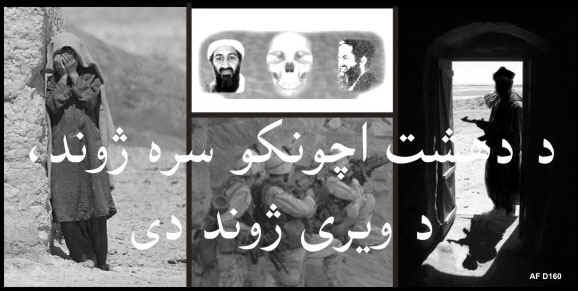
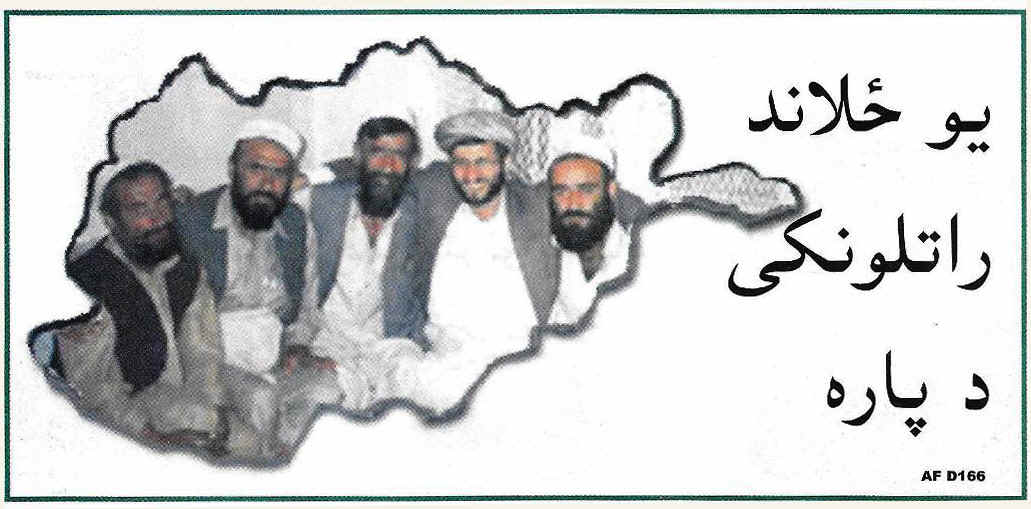
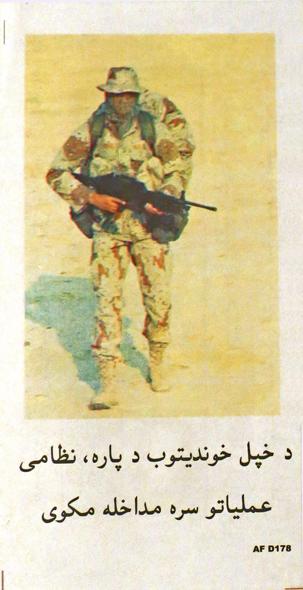
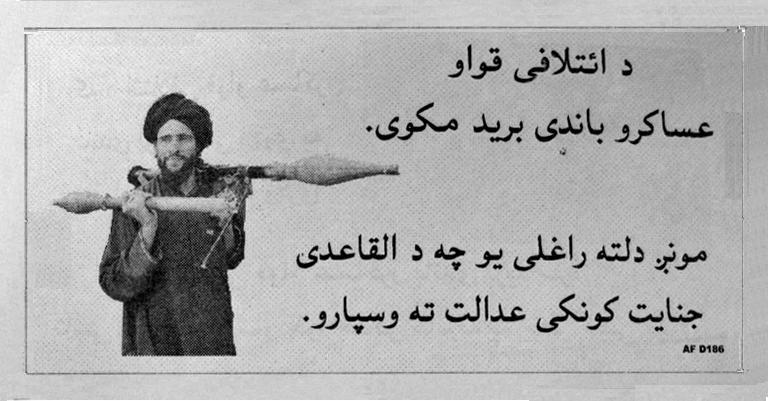
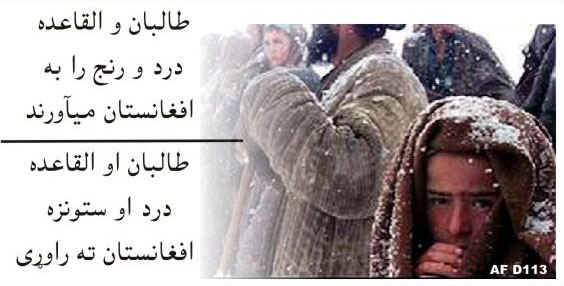
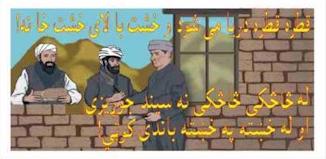
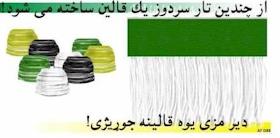
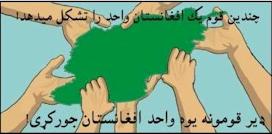
The final three leaflets are very similar. They are all in black and
white and of a more "cartoonish" nature. Each has the exact same
illustration and text on front and back, with the only difference being the language,
one side in Pashto, the other in Dari.
The first shows two Afghans, one with a white turban, one with a black
turban shaking hands. The text is:
2,530,000 copies of this leaflet were disseminated by M129 leaflet bombs
in the first year of the war
Curiously, this consolidation leaflet was still in use long after the
formal cessation of fighting. They were dropped once again in early February
2002 after a flare-up of tribal violence in Gardez, capital of Paktia province
in eastern Afghanistan. United Nations and Afghan government envoys entered the city
to negotiate a peace plan after Pastun tribal factions killed at least 61 people in a
local power struggle.
1,610,000 copies of this leaflet were disseminated by M129 leaflet bombs in the first
year of the war.
It should be noted that during Desert Storm Saddam Hussein sometimes was shown sitting
on a throne of skulls. This leaflet is also known coded AFD93a. The text is changed:
1,570,000 copies of this leaflet were disseminated by M129 leaflet bombs in the first
year of the war.
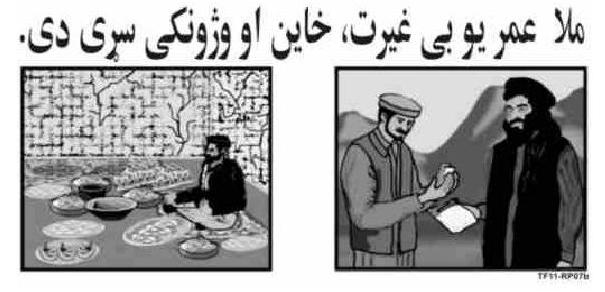
A fancier leaflet shows Mullah Omar feasting at the left, and two Afghans
making a drug deal at the right. The text on the front is:
1,276,000 copies of this leaflet were disseminated by M129 leaflet bombs
in the first year of the war.
I cannot quite make out the code number of this Coalition Leaflet.
The image is clear. At the right is life with drugs and the text:
The single poster shows al-Qaida terrorist Mohammed Atta, and offers
rewards to people who report suspicious activities to the U.S. State Department.
The title text is:
The poster offers rewards of up to $25 million. The poster contains
numerous errors and some details were actually borrowed from other terrorist acts. An
unidentified State Department spokesman said that the poster's creators "took some
liberties with some of the content".
On January 8 the Pakistan-based Islamic Press Agency reported that U.S. planes had
dropped leaflets in Eastern Afghanistan urging civilians not to give fleeing al-Qaida
fugitives refuge, warning that they could be the victims of aerial bombing.
On February 9 the United States Centcom site showed two new leaflets regarding the
occupation of Kandahar Airport. United States Marines from the 15th and 26th Marine
Expeditionary Unit (Special Operations Capable) secured the airport December 15, 2001
during Operation Swift Freedom. Two leaflet-posters are known. The first pictures a Marine
in silhouette with jet fighters in the background. The text is:
The second leaflet poster depicts a number of helicopters and a C17 Globemaster
aircraft. The text is:
Centcom released over a dozen leaflets to the public on February 18, 2002. Many of
these were obviously from previous series that we have already mentioned. Most were
consolidation and nation-building types, but there were some variations of the morale and
reward leaflets we have seen in the past.
In February a number of armed skirmishes took place among the various ethnic and
religious factions of Afghanistan. It became clear that interim leader Hamid Kamil did not
have the full support of his people. Local warlords were consolidating their power and
dividing Afghanistan into private fiefdoms. The United States had no interest in sending a
large occupying force to that nation, so every effort was made to bring the people under
control of the new government through the use of propaganda and the occasional implied
threat of bombing.
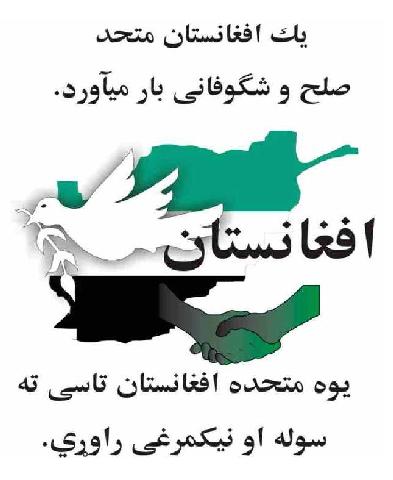
A series of bright green and black leaflets supporting the government were prepared and
dropped. The first shows a white dove of peace over a map of Afghanistan and clasped hands
with the text:
This same leaflet also exists with the code AF5c11L1.
Afghanistan – The partnership of nations is here to assist the people of
Afghanistan.

Leaflet AF5C11L3
A leaflet like the one above shows a map of Afghanistan at the
left, clasped hands in the center, and the planet Earth at the right. The
text on the front is:
The
countries of the world are here for Afghanistan.
Help
has come
Afghans
The text on the back is:
Donor countries of the world have come to help
The
People of Afghanistan

AFG105
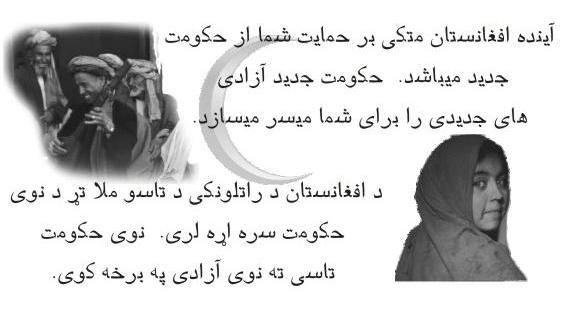
A fourth leaflet shows the exact same illustration and text as leaflet
AF-8-B-11-HB1 on the front; a map of Afghanistan, clasped hands and a white dove of peace.
The text is:
A united Afghanistan offers peace and prosperity.
The back shows Afghan musicians at the left and a young girl at the right.
The text is:
A new government offers new freedoms. The future of Afghanistan
depends on your support of the new government.
1,945,000 copies of this leaflet were disseminated by M129 leaflet bombs
in the first year of the war.
The Rand Corporation seems ambivalent about this leaflet. They like the
crescent moon symbol that suggests that this new regime would be Islamic and point out
that the musicians at top left indicate that the Taliban’s extremist fundamentalist
restrictions on traditional music would be eliminated. They wonder about the smiling girl
on the leaflet that suggests a better life for women, but raises the question of who the
leaflet was aimed at, Afghan men or women. They like the use of the white dove since the
raising of white doves is a traditional Afghan custom, which apparently was banned by the
Taliban.


AFD105B
There is also a similar leaflet coded AFD105b that has added a red
color to the map of Afghanistan on the front. The back depicts happy
Afghan men and children. 300,000 copies of AFD-105b were disseminated
by M129 leaflet bombs in the first year of the war.
The text on
front and back In Farsi and Pashto is:
A united Afghanistan brings peace and prosperity.
Afghanistan
The future of Afghanistan depends on your support of the
government.
The new government will bring new freedom.
A PSYOP officer told me an interesting anecdote about the white dove of
peace depicted on the above leaflet.
There is a funny story in regard to the Peace Dove depicted on some of our
leaflets. Many of the Afghans believed the symbol to be some type of chicken and
they assumed that the leaflet could be used as a coupon that entitled them to a free bird
or meal provided by the Partnership of Nations.

AFG07
A second series of four similar leaflets were coded AFG7-AFG10. The first
shows a young girl at the left, a group on smiling children below, and two boys at the
right. One of the boys has some cash showing prominently from his pocket. The text is:
Help bring back happiness to Afghanistan. Supporting your new
government offers a brighter future for you and your children.
AFG08
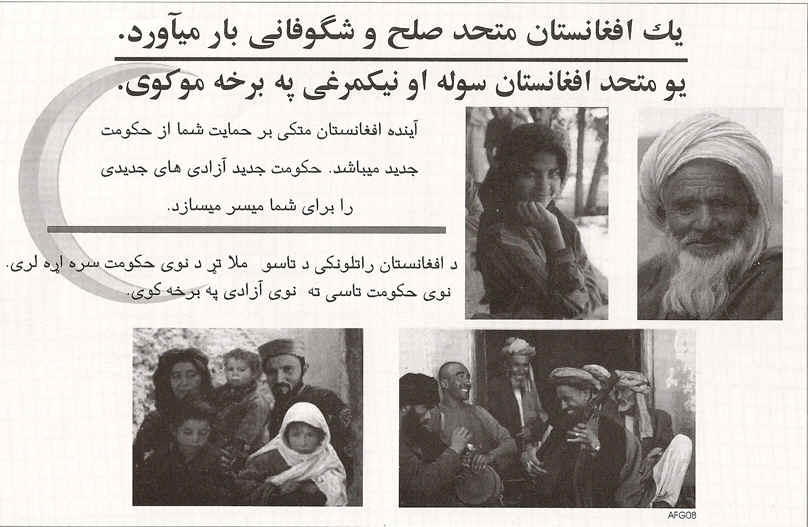
The next leaflet shows a photograph of a young female, an older male in turban, an
Afghan family, and a group of musicians. The text is:
A united Afghanistan = peace prosperity. The future of Afghanistan depends on your
support of the new government. A new government offers new freedoms.

AFG09
Leaflet AFG09 has the exact same text as the previous leaflet, but just two
photographs, that of the Afghan musicians and the young female.

AFG10
The final leaflet of this series shows the four photographs of the young
female, the older male in turban, the Afghan family, and the group of musicians over a map
of Afghanistan with the text:
A new government working for all Afghans. The future of Afghanistan
depends on your support.
In February, U.S. aircraft dropped envelopes adorned with an image of President George
W. Bush and containing two $100 bills. It is assumed that there was a message included in
the envelope, but it is unknown at present.
Although the major fighting portion of the war was thought to be over,
a vicious battle erupted once again on March 2. A group of from 400 to 2000
Taliban and al-Qaida fighters was found to be regrouping near Gardez in the Paktia
Province of eastern Afghanistan. Over 1000 American troops were deployed along with other
Special Forces members of the coalition and Afghan government forces in "Operation
Anaconda." The fight took place at altitudes between 10,000 and 12,000 feet. During
the first ten days of this battle the Coalition forces dropped 4,200,000 leaflets.
AFD114
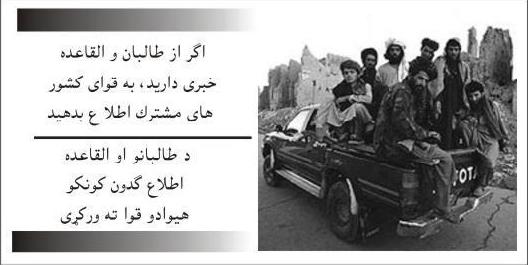
One of the leaflets dropped during the operation shows seven Taliban or
al-Qaida troops sitting in the back of a Toyota pick-up truck. The text is:
Report Taliban and al-Qaida to Partnership of Nations forces.
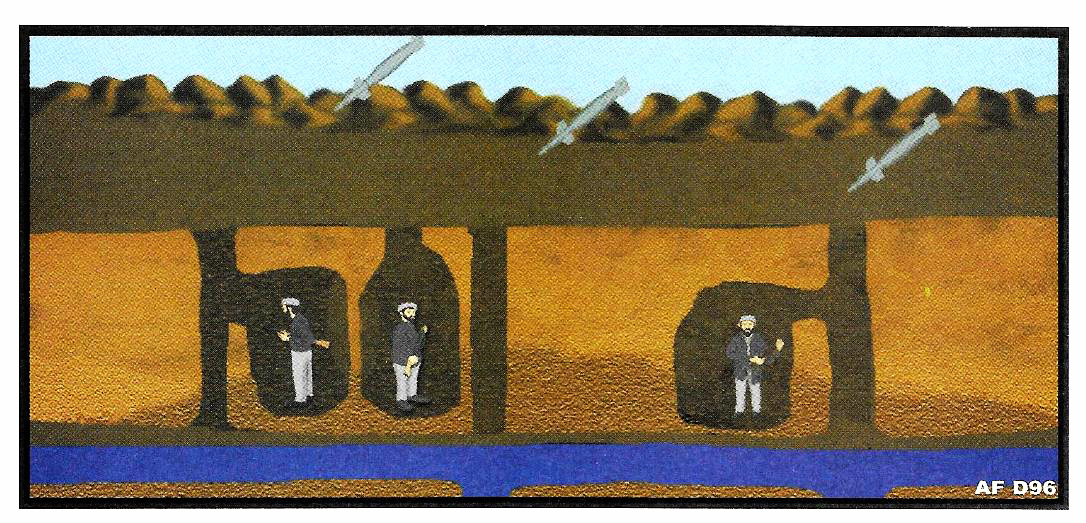
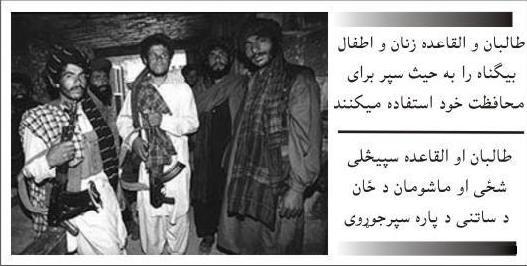
The back of the leaflet shows seven armed Taliban or al-Qaida in a cave. The text
is:
Taliban and al-Qaida use innocent women and children as shields for protection.
60,000 copies of this leaflet were prepared and disseminated by static line boxes in
support of Task Force 11. Another 1,070,000 copies of this leaflet were disseminated by
M129 leaflet bombs in the first year of the war.


AFD149
At about the same time leaflet AFD149 was prepared. It almost seems to be designed
to dare the Taliban to come out and fight. Four armed insurgents are depicted on the
front. The text is:
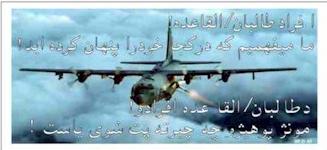
Baradar and Taliban supporters, if you want to fight…
The back of the leaflet depicts three helicopters and a C-130 Hercules aircraft. The
Hercules seems to be releasing all of its flares as it would do if being attacked by enemy
anti-aircraft. The message indicates that the reader is expected to believe that all of
those defensive flares are actually offensive weapons. It is:
We will bring unlimited firepower against you.
30,000 copies of this leaflet were prepared and disseminated by static line boxes in
support of Task Force 11. Another 120,000 copies of AFD149 were disseminated by M129
leaflet bombs in the first year of the war.
[Note] Mullah Abdul Ghani Baradar was a top Taliban leader second only to Mullah
Omar. When Omar disappeared from sight, Baradar took command the Taliban. In this early
leaflet he is warned. Years later, on 16 February 2010, Barader was captured in the
Pakistan city of Karachi.
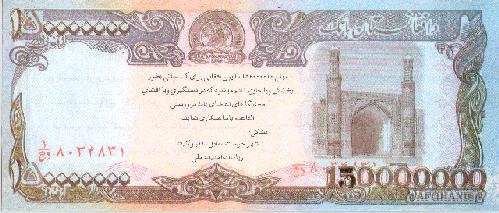
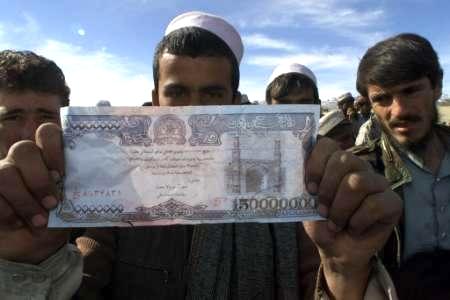
The first propaganda leaflet in the form of a banknote was used during this battle.
Members of the Paktia Province Intelligence Unit distributed them. Because of their large
size (about 264 x 114 mm), they probably were not airdropped. On March 6 local
Afghans were given what appeared to be an enlarged copy of a 10,000
Afghanis banknote. On the front the figure "150,000,000" was emblazoned. The
reward, about $4,285, would be paid to any citizen who aided in the capture of
Taliban or al-Qaida fighters. The notes were circulated around the Shah-i-Kot Valley and
Gardez in Paktia Province.
Text on the back of the imitation banknote is:
Dear countrymen: The al-Qaida terrorists are our enemy. They are the enemy of your
independence and freedom. Come on. Let us find their most secret hiding places. Search
them out and inform the intelligence service of the province and get the big prize.
The same propaganda banknote in a smaller more standard size (75 x 175 mm) was also
prepared and disseminated (see below). Apparently these were dropped over a long period of
time because in one case I was told they were still being used in 2008.
By mid-March another dozen Coalition leaflets had surfaced. Several depicted Hamid
Karzai, interim leader of Afghanistan and a Pashtun tribal leader from Kandahar. These
leaflets pictured Karzai either alone or with other government officials and a map of
Afghanistan.
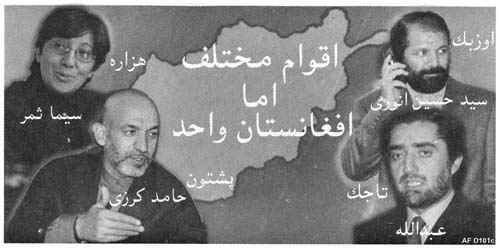
Leaflet AFD-101c
Black and white leaflet AFD-101c depicts Hamid Karzai with three politicians around
a map of Afghanistan. Other similar leaflets are full-color versions and coded AFD-117
(Karzai alone) and AFD-118 (Karzai with the same three politicians). Leaflet AFD-119
depicts Karzai to the left of a flag of Afghanistan. The text on leaflet AFD-101c is:
Many Tribes, but one Afghanistan
On the left: Dr. Sima Samar, Hamid Karzai
On the right: Sayed Hussein Onery, Abdullah Abdullah
Dr. Seema Samar is the Deputy Prime Minister and Chairperson of the Afghan
Independent Human Rights Commission. Dr. Abdullah Abdullah is Afghanistan’s Foreign
Minister. The leaflet points out that the woman at upper left is Hazara, while Karzai is
Pashtun; the upper right person is Uzbek, and the lower right person is a Tajik.
580,000 copies of this leaflet were disseminated by M129 leaflet bombs in the first
year of the war.

Leaflet AFD117
The text on leaflet AFD117 that depicts a portrait of President Karzai is:
Hamid Karzai
Chairman of the Interim Government of Afghanistan.
Leading Afghanistan to a better future
470,000 copies of this leaflet were disseminated by M129 leaflet bombs in
the first year of the war.

Leaflet AFD118
The same image of the four politicians appeared in full color on leaflet AFD118. The
text on this leaflet is:
Support the interim government of the new Afghanistan.
The back of the leaflet showed a peaceful city scene and the text:
Help restore Afghanistan to its former glory.
700,000 copies of leaflet AFD-118 were disseminated by M129 leaflet bombs in the first
year of the war.

Leaflet AFD119
Leaflet AFD119 depicts Karzai and several of his fellow leaders on the front with the
text:
Support the Interim Government of Afghanistan
The back of the leaflet showed rolling hills in Afghanistan and the text:
Restore prosperity to Afghanistan
40,000 copies of this leaflet were disseminated by M129 leaflet bombs in
the first year of the war.
Coalition helicopters flew overhead dropping leaflets celebrating the Afghan New Year,
at the Khartesahki Shrine in Kabul, Afghanistan, on March 21, 2002.

Poster AFC1058
This is a full-sized poster measuring 11 x 17-inches with text in Dari and Pashto. It
depicts President Karzai at the left and the Afghan flag at right. The text is:
The major success of Afghanistan is this; that Afghan people despite different
political ideas, tribes and personalities consider their country secure and they have
returned to rebuild their future.
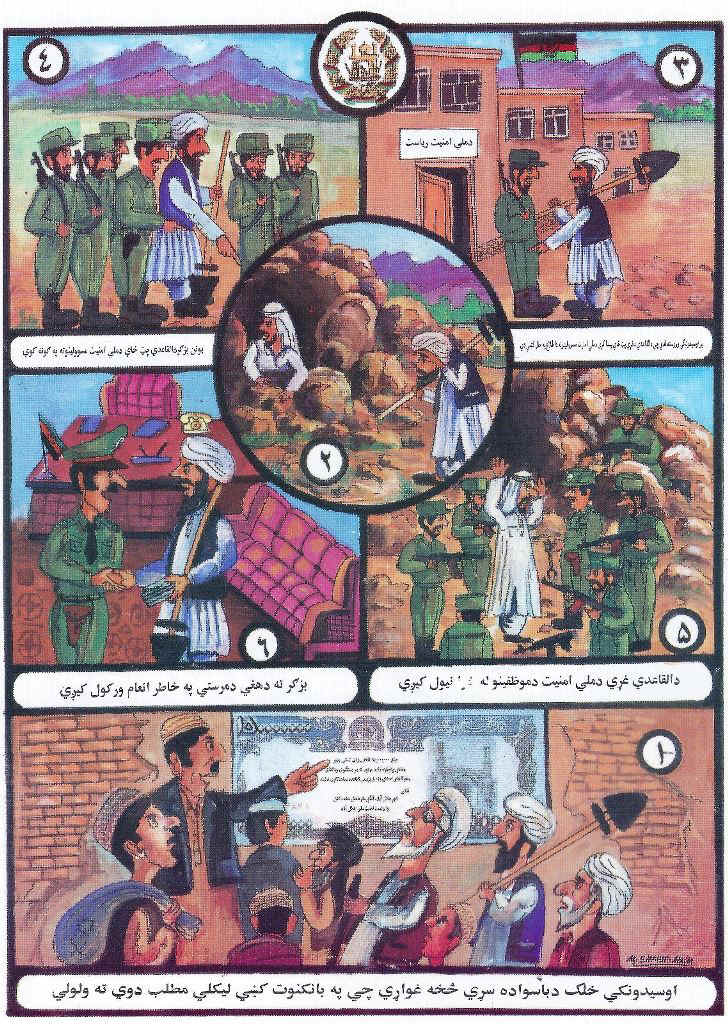
Reward Leaflet - No Code
U.S. military aircraft scattered leaflets over southern Afghanistan on March 23
offering rewards for help in arresting Taliban and al-Qaida fighters. The
leaflets urged people to help U.S.-led coalition forces arrest the Muslim
militants blamed by Washington for the September 11 attacks on the United States. The
leaflet, dropped over the former Taliban stronghold of Kandahar province and the
Spinboldak area bordering Pakistan read in part:
You can earn millions of dollars by helping the allied forces in arresting Taliban
and al-Qaida killers. The reward is so huge that it will be enough for your family,
village and area for your entire life. With this money, you can buy school books, cows,
sheep and pay the doctor's fee and reconstruct houses in the entire village.
The front of the leaflet featured the Afghan banknote and the back was a long
propaganda message. There are six cartoon panels on the front of this colorful leaflet. In
the center two Al Qaida members are hiding in a cave. A local Afghan tells the authorities
and brings them to where the terrorists were last seen. An Al Qaida member is arrested and
in the 5th panel the Afghan informer is rewarded with a handful of cash. The final panel
depicts the banknote and reminds the public that they too can receive such rewards by
informing on terrorist movement.

150,000,000 Reward Banknote leaflet – standard size front

150,000,000 Reward Banknote leaflet – standard size back
On April 22 it was reported that U.S. aircraft dropped Afghan
currency over parts of southern Afghanistan. C-130 transport aircraft dropped the
10,000-Afghani bills over areas near the Afghan border town of Spin Boldak and the nearby
Pakistani town of Chaman. One local resident
claimed to have found eight 10,000-Afghani notes. Another claimed to have found a complete
bundle of 800,000 Afghanis. The value of the Afghani varies, but was about 40,000 to the
dollar at the time of the airdrop. It is unknown if these banknotes were genuine, or
propaganda parodies nearly identical to the oversized notes mentioned above. Parodies of
the 10,000 Afghanis banknote with the figure "150,000,000" added at the lower
right and propaganda text on the front and back are known to exist.
The text on the back of the propaganda banknote above in Dari and Pashto is:
Dear compatriots!
Islam is against terrorism. Let’s identify and arrest members of al-Qaida and
receive honor and a cash award.
We should mention that years earlier in 2000, long before al Qaida’s attack on New
York’s World Trade Center, someone mysteriously distributed overprinted 100 rupee
Pakistani banknotes in Peshawar. The notes bear stamped messages in Pashto and Dari, the
two main languages of Afghanistan, promising a substantial reward for the capture of Osama
bin Laden. The mysterious appearance of the notes allegedly had U.S. officials baffled.
The American consulate in Peshawar said that it is not responsible for making or
distributing these notes.

The Overprinted Pakistani Banknote Offering a Reward for Osama bin Laden
The International Bank Note Society Journal mentioned these Osama bin Laden
overprinted Pakistani banknotes in Volume 51, Issue 3 of 2012. The Dr. Malik Maqbool Joiya
article, entitled “The Special Notes of Pakistan Since 1947 – Overprints Both
Official and Private” says in part:
Sometimes banknotes, leaflets and other items of daily use are used as a
propaganda tool to convey some message or information to a wider population. In February
2000, matchboxes and 100 rupee notes of Pakistan were found in Peshawar, a northwestern
frontier city on the border between Pakistan and Afghanistan, bearing an overprinted hand
stamp message offering a reward for the capturing or providing information which might
help lead to the arrest of Al Qaida leader Osama bin Laden. This overprinted hand stamp
message was found in two major national languages of Afghanistan, Dari and Pashto.
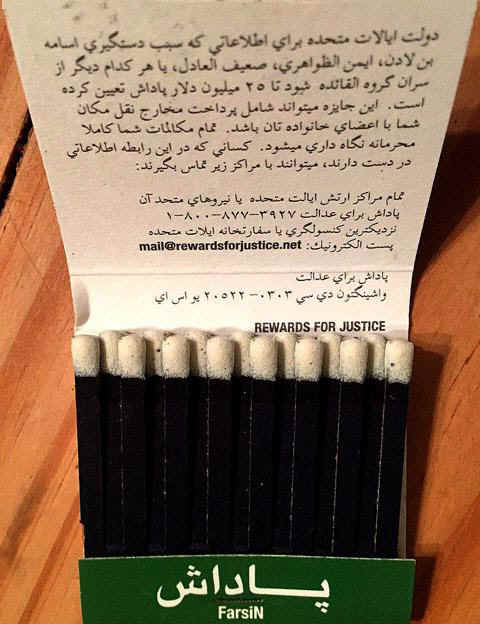
BBC News, on 16 February 2999, reported that the U.S. Consulate in Peshawar
distributed hundreds of match boxes offering a reward for Osama bin Laden. The release of
the match boxes coincided with the appearance of a limited number of Pakistani 100 rupee
notes with an overprinted message on the front and back, in Pashto and Dari. They offered
a reward of five million dollars for Osama bin Laden’s arrest. The U.S. Consulate
however, denied responsibility for making or distributing the overprinted notes. Some
notes have the two languages on both the front and back, other notes have the same
language on the front and back and a third variety has one language on one side of the
banknote.
Although a military victory was quickly won in Afghanistan by a conventional
American Army, the guerrilla war continued for years. Well into 2008 Taliban troops
continued to enter the country from Pakistan and fight along the border areas.
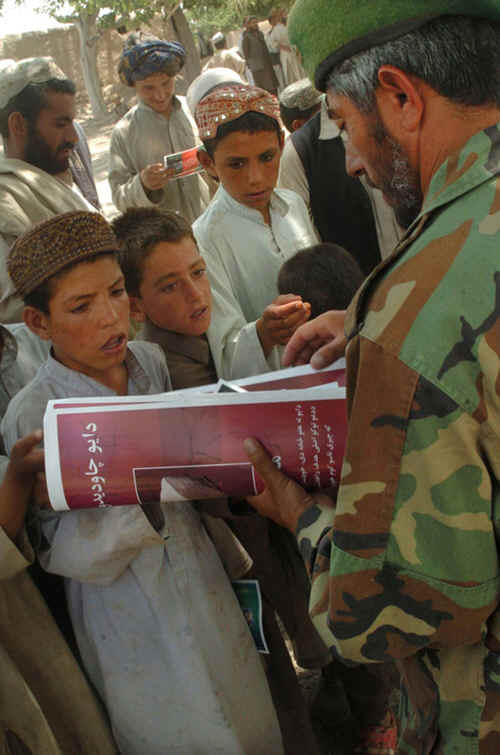
An Afghan national army Captain passes out pro-Islamic Republic of Afghanistan
pamphlets to children in an Andar District village in Ghazni Province, June 25, 2007.
Lieutenant Colonel John A. Nagl discusses the inadequacies of the United
States Army tactics in Counterinsurgency in Modern Warfare, Daniel Marston and
Carter Malkasian, Osprey Publishing, UK, 2008. He blames the American experience in Vietnam
for many of the current problems:
The United States entered the Vietnam War with a military trained and equipped to
fight a conventional war in Europe, and totally unprepared for the counterinsurgency
campaign it was about to wage…The failed American counterinsurgency efforts in
Vietnam are important…The Vietnam hangover resulted in an American unwillingness to
think about and prepare for future counterinsurgency campaigns - a failure that led to a
40-year gap in comprehensive American counterinsurgency doctrine and contributed to the
American military’s lack of preparedness for fighting insurgencies in Afghanistan and
Iraq after the attacks of September 11, 2001.
Note:This article originally covered just the first six months of the war against
terrorism in Afghanistan. We ended the story at that time. The Coalition dropped over 84
million leaflets in the first year of the war in Afghanistan and well over 100 different
leaflets exist. Although our intention was to end the story in April of 2002, recent
activity causes us to add additional information.
Close to one year after the WTC attack, on 7 September 2002, the Coalition
Commanders discussed the PSYOP status of the war. The report stated that the printing
presses, generators, cutters and Risographs (high speed photocopiers) were running at
close to maximum in Ft. Bragg, Kuwait and Diego Garcia. The methods of dissemination and
the total number of leaflets dropped that first year are: 1301 M129 leaflet bombs carried
80,000,000 leaflets; Two PDU5B containers carried 120,000 leaflets; and there were 19
MC-130 Hercules drops. 1,878,000 leaflets were dropped by leaflet box, 1,449 came from the
sea, and another 1,873,211 were disseminated in other ways. The total number of leaflets
distributed that first 330+ days of the war was 83,872,660.
In addition, 138 PSYOP radio programs were broadcast and 523 different scripts were
written. Over 6,000 hours of radio was broadcast by PSYOP forces and close to 4,000 hours
by the Voice of America. To insure that the broadcasts were heard, Coalition forces handed
out 7,670 radios.
In a second similar briefing on 2 October 2002 the following PSYOP objectives were
disclosed: influence regional state sponsors to cease harboring terrorists; isolate
al-Qaida; Isolate the Taliban; the Taliban has no legitimacy to rule; counter
anti-American propaganda; the United States supports an independent and viable
Afghanistan; the Legitimacy of the Coalition actions and the end of civilian interference.
The number of leaflets dropped had risen slightly in the month that passed since the
earlier meeting and now stood at 84,195,268. The PSYOP radio hours had reached 6,622 with
162 radio programs and 538 different scripts.
Radio Scripts
We have mentioned so many scripts above that I suspect the reader
might be wondering what was said in those scripts. Here is an early
broadcast, explaining why the United States has come to Afghanistan (Edited
for brevity):
Theme: The Partnership of Nations is here to help:
On September 11th, the United States was the target of terrorist
attacks, leaving no choice but to seek justice for these horrible crimes. We
are here to take measures against the terrorists that have rooted themselves
in your country. It is not you, the honorable people of Afghanistan, who are
targeted, but those who would oppress you, seek to bend you to their own
will, and make you their slaves.
These terrorists and oppressors are currently in your country,
undermining your economy, your rights as citizens, and your place within the
international community. It does not have to stay that way. But the battle
against these fanatics that feed off the blood of the Afghan people cannot
be won without your help.
It will take the combined efforts of the international community
and you to remove these evil people from Afghanistan. Take the following
action: Do not give food, shelter, or any type of aid to the Taliban or
Usama bin Laden. This will be a great help in the effort.
We have no wish to hurt you, the innocent people of Afghanistan.
Stay away from military installations, government buildings, terrorist
camps, roads, factories, or bridges. If you are near these places, then you
must move away from them. Seek a safe place and stay well away from anything
that might be a target. We do not wish to harm you.
With your help, this conflict can be over soon. And once again,
Afghanistan will belong to you, and not to tyrants or outsiders. Then, you
will reclaim your place among the nations of the world and return to the
honored place your country once held. Remember, we are here to help you to
be free from this terrorism, despotism, and the fear and pain they bring
with them. This is the best way to restore honor and dignity and make your
country a free nation once again.
Since the time of the Soviet invasion, Afghanistan has been a
country in conflict. War and strife have been a constant part of the daily
life of its citizens. Yet time and again, it has not been the people of
Afghanistan, but outsiders who have been the real cause of this pain and
destruction.
Latest in the line of those who would aid in the destruction of
this once great country is Usama bin Laden and the despots called the
Taliban who now rule. These people have continually aided in the destruction
and deterioration of Afghanistan.
Afghanistan’s economy is nearly non-existent, and because of the
Taliban’s support for terrorists such as Usama bin Laden, Afghanistan has
been shunned by the international community. Even now the Taliban undermines
the lives and rights of the people of Afghanistan, treating women as little
more than slaves, and treating the rest of the population little better. The
so-called leaders of the Taliban are disrespectful of Afghan cultural and
Islamic tradition and its proud past.
Now they have brought the anger of the United States and the
international community upon themselves through their terrorist actions.
Now, forces are coming into Afghanistan from outside places to bring justice
because of the atrocities committed by Usama bin Laden and the Taliban.
With the help of the nations of the world, and the people of
Afghanistan, the United States will now remove these tyrants from
Afghanistan. It will take a combined effort to do this, and every bit of
help is needed. Try to find ways to ignore the Taliban and Usama bin Laden’s
requests for help, and do not give them food or shelter.
The United States does not want to injure or kill innocent
civilians, destroy homes, hospitals, mosques, or other public places. This
is most easily avoided if people stay away from military installations,
Taliban government buildings, the camps of Usama bin Laden, and other places
where terrorists gather.
Afghanistan can once again become the proud member of the
international community that it once was. The people of Afghanistan can once
again take control of their own land and set it free from the foreign
invaders and local tyrants who have inserted themselves into its power
structure. Help free yourselves from despotism and rejoin the nations of the
world…

An Afghan reads a U.S. leaflet
44% of Afghans surveyed had seen U.S. leaflets and all claimed to understand the
message. 51% of Afghans surveyed listened to the “Information Radio” on a
regular basis. 57% of those approved of the broadcasts and 30% regularly complied with the
instructions. Some examples of Coalition radio messages are:
Noble people of Afghanistan. Kabul University, once one of Asia’s finest
institutions, has re-opened. Workers have cleared away the rubble and prepared for the new
academic year...The partnership of Nations has donated window glass for several buildings.
Machinery and vehicles have been repaired and donated to insure the university’s
physical plant is operational…Peace and prosperity in Afghanistan grows closer by the
day. Many of Afghanistan’s regional commanders have vowed to put aside ethnic and
tribal disputes. They have sworn allegiance to the Afghan national army….
On March 2, 2003, September 11 mastermind Khalid Shaikh Mohammed, perhaps the
most senior al-Qaida member after bin Laden and his deputy, Ayman al-Zawahri, was arrested
by Pakistani intelligence and CIA agents. Khalid Shaikh Mohammed is the alleged organizer
of the Sept. 11 terror attacks, a 1995 plot to bomb trans-Pacific airliners and a
plan to crash a plane into CIA headquarters. He also planned the bombing of a synagogue in
Tunisia, which killed 19 people.
Mohammed apparently gave Coalition interrogators information on the hiding place of
Osama bin Laden. Immediately after his capture, during the first weeks of March, the task
force renewed the hunt with vigor and dropped a number of PSYOP leaflets over the areas
where bin Laden might be hiding. In all of these leaflets, the 25-million dollar reward
for the fugitive al-Qaida leader Osama bin Laden is the main theme.

U.S. and Pakistani forces searched for al-Qaida members on March 7 in a
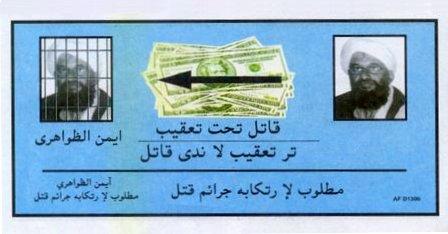
mountainous area near the borders with Afghanistan and Iran. They distributed a leaflet
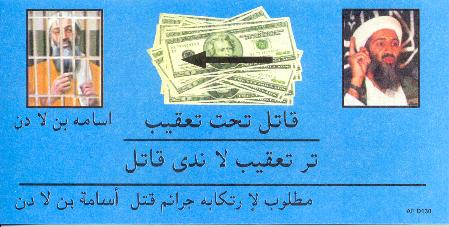
that showed bin Laden speaking at the right, and behind bars at the left. Similar leaflets
appeared the same day in Islamabad, and in Eastern Afghanistan and portions of Pakistan.
The leaflets offered rewards for the capture of bin Laden and other al-Qaida leaders. The
leaflet appears to be a black and white version of the "bin Laden behind bars,"
(AFD-29n).
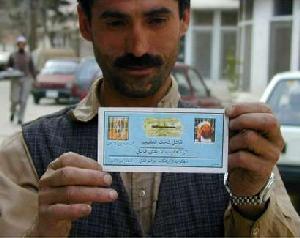
A second full-color leaflet had the same general appearance on the front,
except that the pictures of bin Laden are smaller and there is added text at the bottom.
The front is identical to AFD-130. However, instead of the banknotes pictured on AFD-130,
the back of this new leaflet depicts bin Laden speaking at the top, in jail at the bottom,
while in the center an Afghan greets a Coalition soldier. The Coalition dropped this
leaflet about March 8 near the Pakistani border city of Chaman. The leaflet code is
unknown.
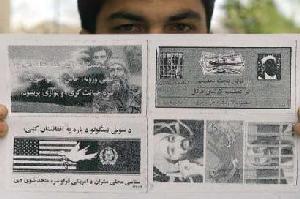
Coalition forces disseminated two black and white leaflets on Spin Boldak,
an Afghan border town, during the first week of March. The first is identical to the
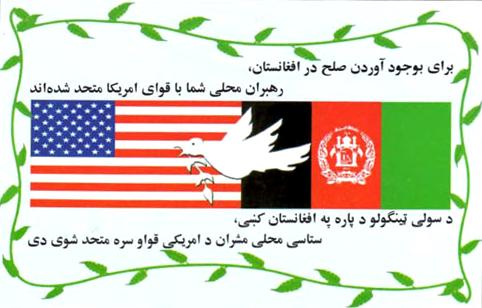
leaflet mentioned above, but without color. The second leaflet is brand new. The flags of
the United States and Afghanistan appear on the front with a white dove of peace. The back
shows bin Laden and some other leaders to the right of what appears to be the cloud from
an explosion. This leaflet urges Afghans to join the hunt for bin Laden.
On March 7, The Associated Press reported regular leaflet drops over vast stretches of
eastern Afghanistan and western Pakistan. The target areas are Pakistan's southwestern
Baluchistan province and in the border regions of the North West Frontier Province, a
suspected haven for terrorists.
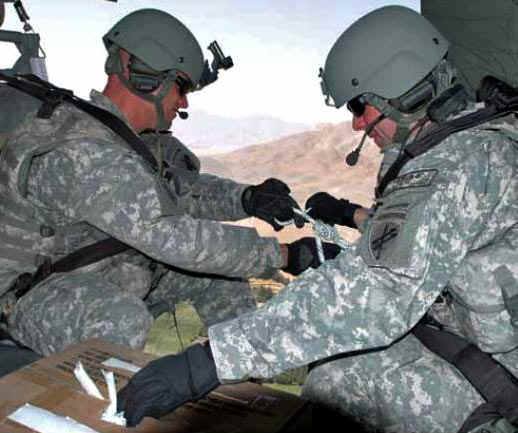

PSYOP Soldiers drop leaflets over Afghanistan
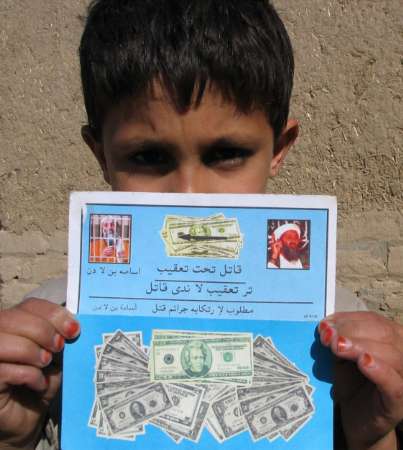
The article mentions a bright pink leaflet with two pictures of bin Laden, one free and
one behind bars, and a stack of US $20 bills in the center. The text is:
There is US $25 million for anyone providing information to the arrest of Osama bin
Laden.
A second leaflet in Pashto urges ordinary Afghans to surrender terrorists. It shows an
Afghan family with the inscription:
This good life is there for Afghans without the Taliban, al-Qaida and Gulbuddin
Hekmatyar. Help us give you a better life.
Hekmatyar is a local warlord known as "the vampire" and famous for his
cruelty to captives. One of his alleged favorite pastimes is lighting gunpowder on the
eyes of his prisoners.
A third leaflet shows destroyed homes and al-Qaida in training. Some of the text is:
Help us bring them to justice. Only you can help us. Don't be deceived by them.
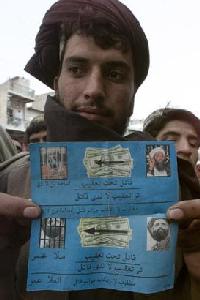
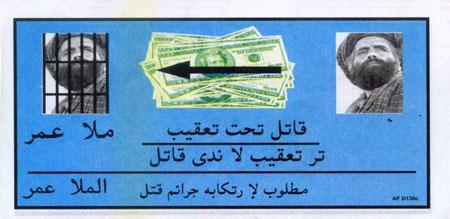
On March 9, a blue poster was distributed around Chaman, Pakistan. The poster depicted
the Osama bin Laden leaflet speaking and behind bars vignette at the top, and a second
such vignette with Mullah Omar speaking and behind bars below. Some of the text of this
leaflet is "chase murderers."
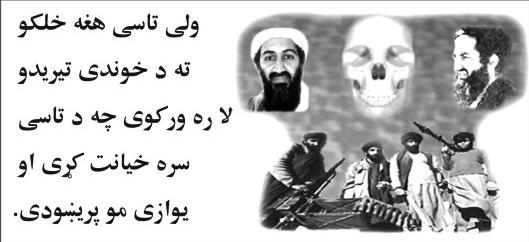
We should stop for a moment and point out that it was not uncommon for the Partnership
of nations to personally attack Osama bin Laden. He has been depicted as a skull face
(AFD56b), playing chess, walking the dog (AFD51c), and even clean shaven and in a
European suit (TF11RP03).
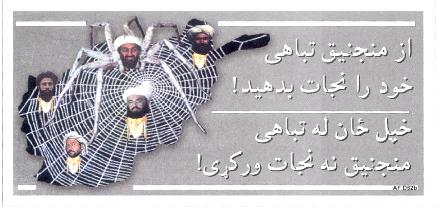
AFD52b
It was done again in leaflet AFD52b. This leaflet pictures bin Laden as a
spider, his web over a map of Afghanistan, with the heads of four Taliban members enmeshed
in his trap. The text is:
Save yourself from the fire of Manjaneeq.
200,000 copies of this leaflet were disseminated by M129 leaflet bombs in
the first year of the war.
The meaning requires a knowledge of the Holy Koran. The manjaneeq is a
13th century catapult used to throw boulders and fire balls into enemy emplacements and
strongholds, and sometimes to catapult humans into fire. In the Koran, Ibrahim nabi was
placed in the manjaneeq. The Lord God (Allah) sent Jibraeel to ask Ibrahim if he needed
anything. He replied that he did not. Jibraeel could not understand why Ibrahim would
reply that he needed nothing from Allah. Not unlike Daniel in the Lion's den, the answer
was:
If it is Allah's will that I be martyred then how can I ask that He
save me? If he wishes to save me then I have no need to ask.
This is an example of qalbe saleem (the peaceful, submissive,
accepting heart). Perhaps the true meaning of the text is lost on the western mind. A
Muslim friend says about the leaflet text, "It tells the people to save themselves
and not find themselves in the fire of manjaneeq by listening to bin Laden and his
followers and their evil thoughts." Curiously, when the U.S. translated the text for
the public to avoid confusion they said the text was:
Free yourself from the web of destruction.
The back of the leaflet depicts Afghans that the Taliban have executed by hanging.
The text is:
For some it is already too late.

Staff Sergeant Dean Penrod releases leaflets
Warrant Officer 4 Roger M. Gordon flew CH-47 Chinook helicopters for D Company
of the 113th Aviation Regiment attached to Task Force Storm during Operation Enduring
Freedom in Afghanistan. He was stationed at Kandahar Airbase just south of the city of Kandahar. In
the spring 2005 photograph above, Staff Sergeant Dean Penrod releases leaflets over a
village just north of the city of Kandahar along the Argandab River valley. WO4
Gordon told me:
The purpose of the leaflet drop was to encourage the locals not to support the
Taliban and warn of the consequences for those that did. The next day, elements of
the 173rd Airborne Infantry Brigade (Sky Soldiers) air assaulted into the same village as
a show of force. The purpose of the demonstration was to deny the Taliban sanctuary
anywhere in the Brigade's sector and to help build confidence in the locals that we
were there to protect them.
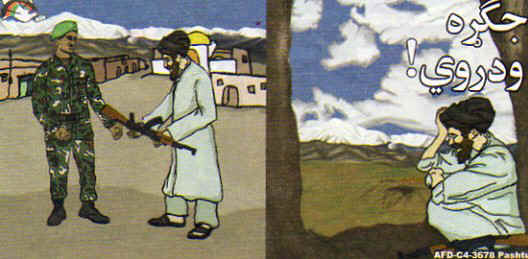
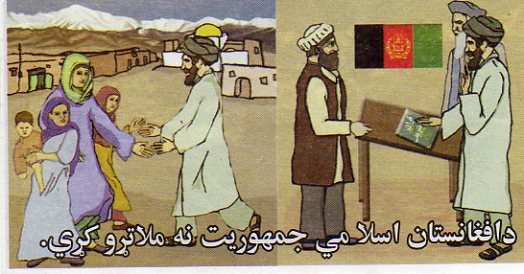
AFD-C4-3678 Pashtu
This is one of the leaflets that Gordon dropped over the Argandab River valley. On
the front we see a Taliban member thinking about his plight, then handing his AK-47 to a
Coalition soldier. The text is:
Stop the war
On the back he pledges loyalty to the Afghan nation and in the last panel he returns
home to a loving wife and children. The message is clear. Act correctly and in peace and
live happily ever afterwards. The text is:
This is the United Islamic Republic of Afghanistan and it does not
belong to foreigners.
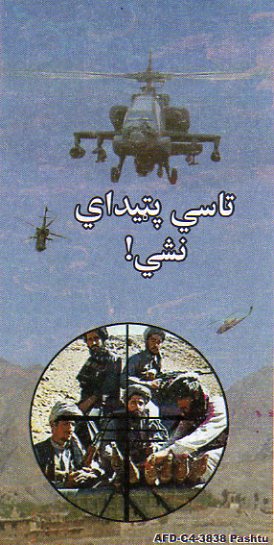
AFD-C4-3838 Pashtu
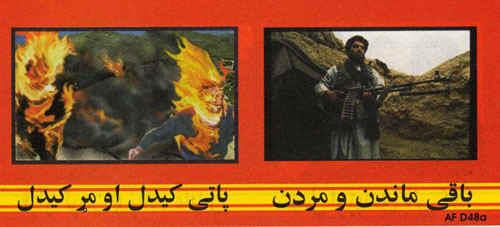
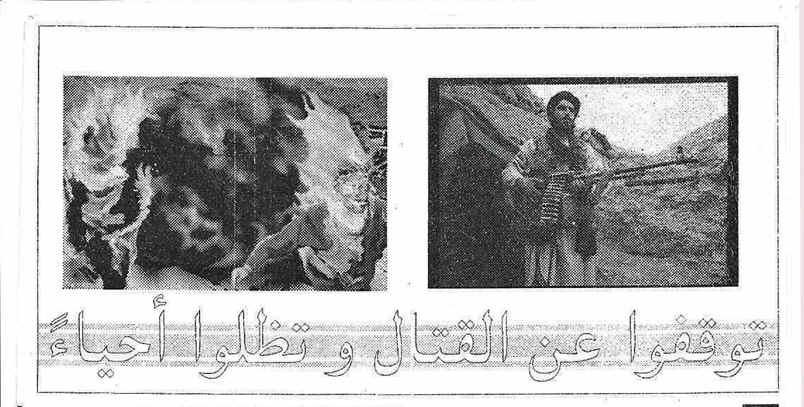
In this leaflet a group of Taliban is depicted holding rifles and rocket-propelled
grenades. They are in the sights of a Coalition attack helicopter. The text is:
Wherever you hide, they will find you
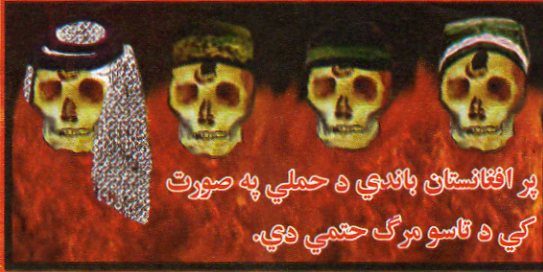
On the back four have been killed and are depicted as skulls, dead and burning in Hell.
The message is clear. Remain in the Taliban and die. The text is:
Any attack on Afghanistan means certain death

AFD-F3-3834 Pashtu
This leaflet
displays a map of Afghanistan in the center, surrounded by armed terrorists
at the right and left. The text identifies them:
The Taliban, an Arab terrorist, al Qaeda
The back has
some sort of Afghan decorative design and the text:
The Taliban and foreign terrorists.
The Taliban leadership does not want you free.
They want to rule over you.
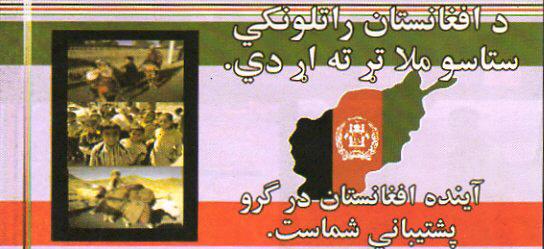

AFD-F4-171e PashtuDari
A third leaflet dropped by Gordon is more crowded and "busy." One side
shows a map of Afghanistan and three photographs of happy children. The text is:
The future of Afghanistan is in your hands.
The other side depicts four photographs; a larger one showing a Taliban and
Coalition soldier shaking hands, and three smaller ones of armed Taliban and weapons
systems crossed out with as red “X.”
To Report on the terrorists and help the national army is your national
responsibility.
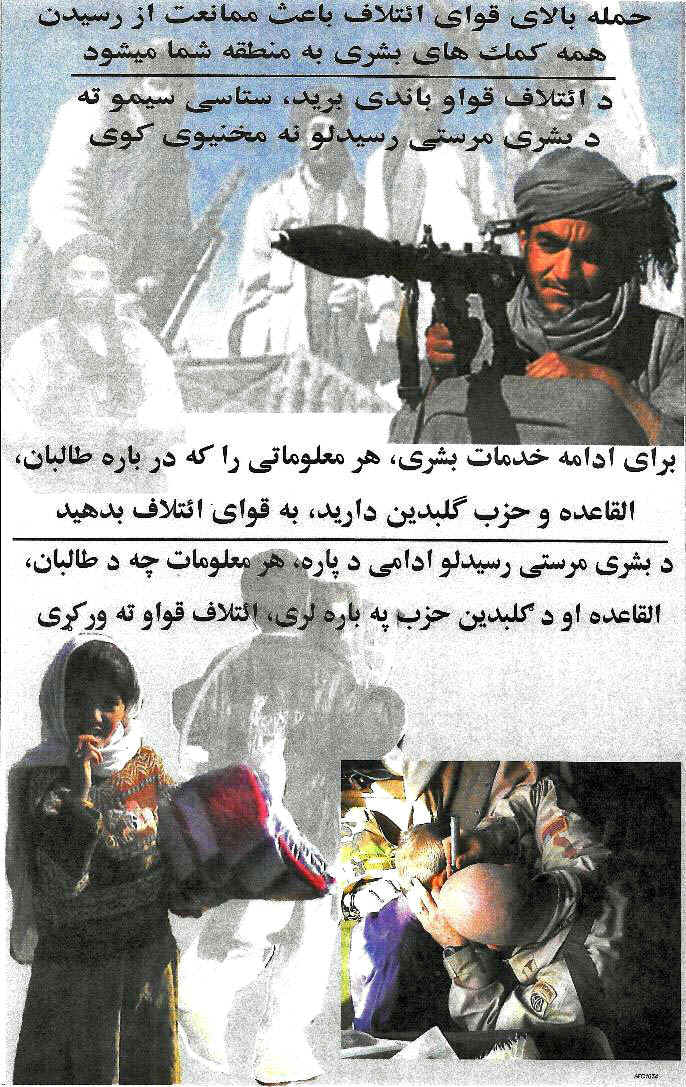
Poster AFC1074
This full-sized poster measures 11 x 17-inches in size and is printed in full color in
Dari and Pashto. At the top it depicts a terrorist with a rifle-propelled grenade. Below,
it depicts a young Afghan and military doctor working on an injured patient. The text is:
Attacks on Coalition Forces prevent the delivery of all humanitarian help to your
area.
For the continuation of humanitarian services, give the Coalition Forces all of the
information you have about the Taliban, Al Qaida and Hezb-e Islami Gulbuddin.
The Hezb-e-Islami Party was founded in 1977 by Gulbuddin Hekmatyar, who was later named
the head of HIG. During the Soviet War in Afghanistan, Hekmatyar and his party operated
near the Pakistani border against Soviet Communists. The bombardment of the capital by HIG
in 1994 is reported to have resulted in the deaths of more than 25,000 civilians. HIG is
believed to have local alliances with the Taliban, al-Qaida. Its main area of operation is
northeastern Afghanistan, such as the provinces of Kunar, Laghman and Paktia


AFD01aaHB3247
This leaflet is similar to the one above in that it shows three photographs of the
enemy Taliban on one side along with an Afghan shaking hands with an American soldier,
while on the other side it depicts the Afghan flag and three photographs of happy
children. The text is:
Reporting to the Afghanistan National Army and its Coalition partners
about the insurgents is your national duty.
Afghanistan’s future needs your support.

The Peace Newspaper
The PSYOP units printed more than just leaflets and posters. They also published
newspapers such as “Peace.” This newspaper was distributed about
monthly and carried news about Afghanistan and various PSYOP themes in Dari, Pashto, and
English. PSYOP teams gave it out to schools as a teaching aid since many schools had no
reading material. If they had no books, at least they would have the American newspaper to
read and discuss. Of course, the stories were nation-building consolidation articles so
this played into the peaceful reconstruction of Afghanistan. The newspapers were also
distributed to crowds, and sometimes within restaurants and shops. The main problem was
the high rate of illiteracy, so we tried to target places where there was a good chance
that someone could read.

Staff Sergeant Jesse Wison send me this photo. He said:
The boy is holding an issue of the Peace Newspaper. We published the
newspaper once a week. All articles in the paper were crafted/written by the
PSYOP Specialists in the Product Development Detachment. We used stories
from the Associate Press or other sources and tailored them to highlight the
good going on, either by the Afghanistan National Army, the Afghanistan
National Police, or coalition forces, and also to highlight the bad that the
Taliban or other forces were doing.
Some Problems with the Newspapers in Afghanistan
There were some minor problems with the printing and distribution
of newspapers in Afghanistan. Retired Army Colonel Bill Gormley who deployed
to Afghanistan in 2003 mentions some of these in an article titled “The
failed promise: Reflections on America’s Afghanistan experience,” printed in
the Small Wars Journal, 3 April 2022. Some of his comments are:
When I was the Senior PSYOP Officer, I put my development
detachment leader in charge of the radio broadcast and newspaper staff. My
intent was to get more synergy between all the different types of media we
were using. For example, the newspaper listed the radio station’s
frequencies and program schedule, and some of the newspaper’s articles were
modified and read on radio broadcasts. Some of the artwork from leaflets and
handbills were also reprinted in the newspaper. For my perspective, it did
not make sense to have a detachment led by an experienced mid-grade PSYOP
officer making leaflets, posters, and handbills while the radio detachment
was led by a new second lieutenant and the newspaper section was led by a
young sergeant, each largely doing their own thing. Together, the
active-duty soldiers who developed radio scripts and newspaper articles, and
my Reserve PSYOP development detachment made a formidable team and developed
some what I thought were good materials. My PSYOP soldiers provided the
newspaper and radio updated target audience analysis, and my illustrators
did artwork for the newspaper.
In 2003, I tried to cut the number of copies of our newspapers we
had printed by a local contractor because my teams were not able to
disseminate all of them. It seemed like a waste of money to print so many
papers. Even, getting the papers from Bagram to the teams each month was a
problem to due to limited space on aircraft or locally hired trucks. I was
overruled by the Psychological Operations Task Force; I suspect because the
less impressive number would not look as good on efficiency reports. Getting
support became a big problem later as units we had established relationships
with, began to redeploy. It
became a hassle to even get approval to travel to Kabul to pick up our PSYOP
newspapers which we had printed by a local contractor, since all ground
travel off Bagram needed approval of an officer with the rank of Colonel,
which we did not have in country.
American Companies Join the War on Terror

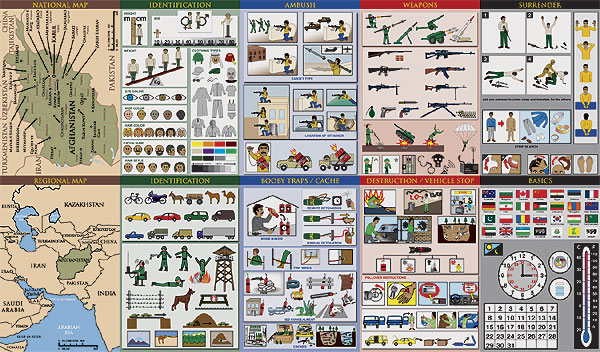
Kwikpoint
Afghanistan Visual Language Survival Guide
Although this article is about the “official” PSYOP and paper products
produced by military units, it is clear that many products that were once printed by
military sources, such as “pointee-talkie” cards, are now being produced by
private companies. For instance, Gaia Communications of Arlington, Virginia, has
prepared a number of handy cards for use in Iraq and Afghanistan that are as good as or
better than anything prepared by the military to this point. The cards are highly
colorful, sturdily made, fold out, and contain a wealth of information that is valuable to
Allied troops. The products, sold under the name Kwikpoint, consists
of such items as an Afghanistan Visual Language Survival Guide, an Iraqi Visual Language
Survival Guide, a Military Police Visual Language Translator, and a Special Forces
Military Translator. The Afghan booklet has 10 panels of text in Pashto, Dari and Farsi on
one side and 10 panels of pictures on the other side.
According to Kwikpoint, users have forwarded positive testimonials. Almost all
of them are from Iraq, but the cards have been tested in Afghanistan:
We are in the middle of Baghdad and the Kwikpoint Iraqi Visual Language Survivor
Guide cards are incredibly helpful and good. They are a hot commodity. We’d like to
give some to the hospitals to interface with them. The text is also helpful-our Iraqi
translator says any Iraqi can understand it. CPT Arosemena, 1st Armored-2nd Brigade
In Iraq, our unit had the Kwikpoint Iraqi Visual Language Survival Guide on
patrols. Using the card helped us find weapons caches by determining if information Iraqis
brought to us was good enough to take it up the chain of command. Iraqis kept trying to
come and tell us who was shooting at us I would have them draw pictures after showing them
how Kwikpoint pictures communicate. I also used it in conjunction with a map to point
things out. SGT Darin Dowdy, 3rd Infantry Division.
We, the Army/Navy Science Advisors, USASOC and Defense Language Institute have
distributed around 10,000 to date. Everyone wants more, principally, the 18th Corps and
Marine Expeditionary Force’s and the 30th MED from V Corps has some number as well.
They are in use in both Operation Enduring Freedom and Operation Iraqi Freedom. John
Grills, Deputy Director, AMC Fast.
Face-to-Face Operations
Psychological warfare is not just leaflets and radios. Sometimes it can be the personal
touch that changes attitudes or projects power. We hear many such stories. Here is one.
The 345th psychological Operations Company out of Dallas, Texas, is an Army Reserve
Unit assigned to the 16th Psychological Operations Battalion of the 2nd Psychological
Operations Group. They were deployed to Afghanistan where they supported the 3rd and 7th
Special Forces Groups. Seven tactical PSYOP teams were scattered throughout the country,
Team 2-3 “Gator” was operating out of Mazar-E-Sharif where it found itself in
the middle of a power battle between four different factions; the Hezbi-wadat,
Jumbish-i-islami, Jamiat-i-islami, and Hericot-i-islami. These groups all resisted the
national authority and the team took part in a small operation that clearly told the
people that the new government had power and could enforce its rulings. One of the team
members told me this story:
One afternoon in May 2002, a Special Forces patrol found itself close to a
firefight between two of the rival factions. They learned that two teenage boys had been
taken into Jamiat-i-islami custody and sent to a local security compound run by a ruthless
chief named Fadah for execution. The father
of the boys approached the members of the 345th POC and asked for help. My team chief and
two unit members immediately went to the compound to discuss the fate of the two innocent
boys. We were able to convince Fadah that releasing the two young men would help the
ongoing effort to continue a Northern Alliance offensive against remnants of hostile
Taliban and Al-Qaida and not allow factional differences to collapse into another civil
war. After a talk over a chess match, the Chief came around. Meanwhile, another team
member explained the meaning of the leaflets that some of the police station personnel had
acquired from our team's distribution. I maintained security and monitored radio
transmission with the TAC-P not far from their location. With a peaceful resolution
now in place, Team 2-3 “Gator” not only secured the boys’ freedom and the
respect of the families and community, but delivered a highly successful psychological
blow to the enemy. The father of the boys met a US interpreter at the safe house and
dictated a letter thanking the Americans for their efforts.
The Jamiat-i-islami was one of the groups opposed to the Taliban. It was part of an
alliance called the National Islamic United Front for the Salvation of Afghanistan,
commonly known as the United Front. The United Front supported the government ousted by
the Taliban, the Islamic State of Afghanistan (ISA). It is clear why such a movement would
be against a national authority that was not Islamic in nature.
Cash Reward for Weapons
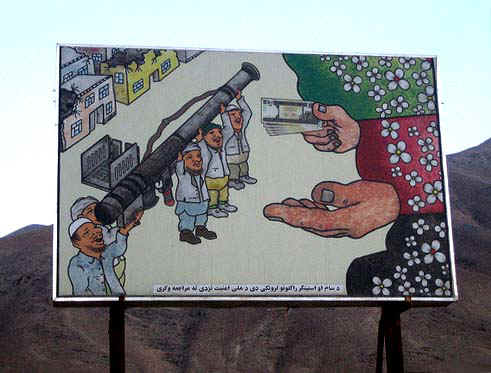
Billboard in Afghanistan offering cash for Stinger Missles